Elasmobranchii (sharks and rays) >
Carcharhiniformes (Ground sharks) >
Carcharhinidae (Requiem sharks)
Etymology: Carcharhinus: karcharos (Gr.), sharp or jagged; rhinus, an ancient name for sharks, from rhine (Gr.), rasp, both words alluding to a shark's jagged, rasp-like skin. (See ETYFish); signatus: Latin for marked, probably referring to indentation on outer margins of upper teeth (described from jaws only). (See ETYFish).
More on author: Poey.
Environment: milieu / climate zone / depth range / distribution range
Ecology
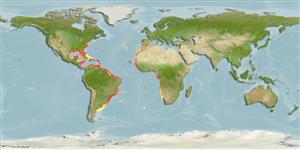
Marine; benthopelagic; depth range 0 - 600 m (Ref. 244), usually 50 - 100 m (Ref. 244). Subtropical; 11°C - 16°C (Ref. 244); 39°N - 43°S, 98°W - 15°E (Ref. 55190)
Western Atlantic: Delaware to Florida (USA), Bahamas, and Cuba; southern Brazil, Argentina (Ref. 244). Eastern Atlantic: Senegal to Côte d'Ivoire, Ghana to Cameroon, Democratic Republic of the Congo, Angola, off northern Namibia (Ref. 244, 5578).
Length at first maturity / Size / Weight / Age
Maturity: Lm 202.5, range 150 - 205 cm
Max length : 280 cm TL male/unsexed; (Ref. 244); common length : 200 cm TL male/unsexed; (Ref. 26999); max. published weight: 76.7 kg (Ref. 40637)
Dorsal
spines
(total): 0;
Dorsal
soft rays
(total): 0;
Anal
spines: 0;
Anal
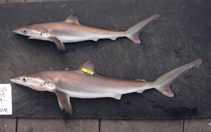
soft rays: 0. A slim shark with a very long, pointed snout, large eyes, and small jaws with oblique-cusped serrated upper teeth; dorsal fins low with elongated rear tips; interdorsal ridge present (Ref. 5578). Grey-brown above, white below; no conspicuous fin markings (Ref. 5578).
Coastal and semi-oceanic species found on or along outer continental and insular shelves (Ref. 244). Found to depths of 40 m (Ref. 26938). Forms schools (Ref. 244). Nocturnal (Ref. 5578), and feeding mainly on small bony fishes and squid (Ref. 244). Viviparous (Ref. 50449). Off West Africa, recorded water parameters at 90 to 285 m, where it was caught includes: temperature = 11 to 16°C; salinity = 36 ppt; oxygen = 1.81 ml/l (Ref. 244). Not known to be dangerous to people (Ref. 244).
Viviparous, placental (Ref. 50449), with 4 to 12 young in a litter (Ref. 244). Size at birth about 60 cm (Ref. 244). Distinct pairing with embrace (Ref. 205).
Compagno, L.J.V., 1984. FAO Species Catalogue. Vol. 4. Sharks of the world. An annotated and illustrated catalogue of shark species known to date. Part 2 - Carcharhiniformes. FAO Fish. Synop. 125(4/2):251-655. Rome: FAO. (Ref. 244)
IUCN Red List Status (Ref. 130435)
Human uses
Fisheries: commercial
More information
ReferencesAquacultureAquaculture profileStrainsGeneticsElectrophoresesHeritabilityDiseasesProcessingNutrientsMass conversion
Tools
Special reports
Download XML
Internet sources
Estimates based on models
Preferred temperature (Ref.
123201): 15.8 - 27, mean 21.7 °C (based on 178 cells).
Phylogenetic diversity index (Ref.
82804): PD
50 = 0.5000 [Uniqueness, from 0.5 = low to 2.0 = high].
Bayesian length-weight: a=0.00457 (0.00292 - 0.00715), b=3.08 (2.96 - 3.20), in cm total length, based on LWR estimates for this species & Genus-body shape (Ref.
93245).
Trophic level (Ref.
69278): 4.6 ±0.0 se; based on diet studies.
Resilience (Ref.
120179): Very Low, minimum population doubling time more than 14 years (tm=8-10; Fec=4; Tmax=17; K=0.12).
Fishing Vulnerability (Ref.
59153): High to very high vulnerability (73 of 100).