Elasmobranchii (sharks and rays) >
Carcharhiniformes (Ground sharks) >
Carcharhinidae (Requiem sharks)
Etymology: Carcharhinus: karcharos (Gr.), sharp or jagged; rhinus, an ancient name for sharks, from rhine (Gr.), rasp, both words alluding to a shark's jagged, rasp-like skin. (See ETYFish); albimarginatus: albus (L.), white; marginatus (L.), bordered, referring to white fin tips. (See ETYFish).
More on author: Rüppell.
Environment: milieu / climate zone / depth range / distribution range
Ecology
Marine; reef-associated; depth range 1 - 800 m (Ref. 6871), usually 20 - ? m (Ref. 30874). Tropical; 32°N - 31°S, 31°E - 77°W (Ref. 55177)
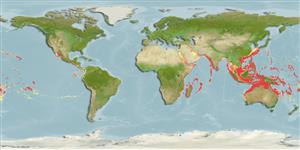
Indo-Pacific: Red Sea and East Africa, including Madagascar, Seychelles, Aldabra Group, Mauritius and the Chagos Archipelago east to Tuamotu Is., north to Japan and south to Australia (Ref. 244). Not confirmed in west Atlantic (Ref. 58085).
Length at first maturity / Size / Weight / Age
Maturity: Lm 187.3, range 160 - 200 cm
Max length : 300 cm TL male/unsexed; (Ref. 2334); common length : 200 cm NG male/unsexed; (Ref. 30874); max. published weight: 162.2 kg (Ref. 40637)
Dorsal
spines
(total): 0;
Dorsal
soft rays
(total): 0;
Anal
spines: 0;
Anal
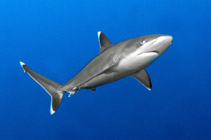
soft rays: 0. First dorsal fin and pectoral fins angular, and not expanded; upper teeth triangular; interdorsal ridge present (Ref. 1602, 5578). Dark grey or grey-brown above, white below; all fins with conspicuous white tips and posterior margins (Ref. 9997).
An inshore and offshore shark found over or adjacent to continental and insular shelves and offshore banks (Ref. 244). Prefers offshore islands, coral reefs and banks (Ref. 244). Benthopelagic (Ref. 58302). Feeds mainly on benthic and midwater fishes (including scombrids), also rays, cephalopods (Ref. 244, 1602), and small sharks and crustaceans (Ref. 89972). Viviparous (Ref. 50449). Up to 11 young, size 50 to 60 cm, are born after a gestation period of 12 months (Ref. 1602, 37816). Potentially dangerous (Ref. 9997). Presumably taken by fisheries in areas where it occurs (Ref. 9997). Caught irregularly by shark and tuna longline and tuna gillnet fisheries. Utilized for its fins (high value in adults), meat, skin and cartilage (Ref.58048). Probably utilized fresh and dried-salted for human consumption (Ref. 9997).
Viviparous, placental (Ref. 50449). With 1 to 11 pups per litter (usually 5 or 6) (Ref. 244). Gestation period is about one year, young are born in summer (Ref. 244). Size at birth 55 to 80 cm (Ref. 2334); 713-81 cm TL (Ref.58048). In southern hemisphere, both breeding and pupping occur in summer (Ref. 37816). Distinct pairing with embrace (Ref. 205).
Compagno, L.J.V., 1984. FAO Species Catalogue. Vol. 4. Sharks of the world. An annotated and illustrated catalogue of shark species known to date. Part 2 - Carcharhiniformes. FAO Fish. Synop. 125(4/2):251-655. Rome: FAO. (Ref. 244)
IUCN Red List Status (Ref. 130435)
Threat to humans
Traumatogenic (Ref. 4690)
Human uses
Fisheries: commercial; gamefish: yes
More information
ReferencesAquacultureAquaculture profileStrainsGeneticsElectrophoresesHeritabilityDiseasesProcessingNutrientsMass conversion
Tools
Special reports
Download XML
Internet sources
Estimates based on models
Preferred temperature (Ref.
123201): 13.9 - 29, mean 27.1 °C (based on 4094 cells).
Phylogenetic diversity index (Ref.
82804): PD
50 = 0.5000 [Uniqueness, from 0.5 = low to 2.0 = high].
Bayesian length-weight: a=0.00437 (0.00215 - 0.00887), b=3.09 (2.92 - 3.26), in cm total length, based on LWR estimates for this species & Genus-body shape (Ref.
93245).
Trophic level (Ref.
69278): 4.2 ±0.5 se; based on diet studies.
Resilience (Ref.
120179): Very Low, minimum population doubling time more than 14 years (Fec=1).
Fishing Vulnerability (Ref.
59153): Very high vulnerability (90 of 100).
Nutrients (Ref.
124155): Calcium = 4.53 [0.96, 23.65] mg/100g; Iron = 0.345 [0.087, 0.987] mg/100g; Protein = 22 [19, 24] %; Omega3 = 0.116 [0.047, 0.277] g/100g; Selenium = 55 [16, 154] μg/100g; VitaminA = 40.5 [15.2, 111.1] μg/100g; Zinc = 0.488 [0.233, 0.953] mg/100g (wet weight);