Teleostei (teleosts) >
Carangiformes (Jacks) >
Carangidae (Jacks and pompanos) > Caranginae
Etymology: Caranx: French, carangue, the name of a Caribbean fish; 1836 (Ref. 45335); fischeri: Named for Dr. Walter Fischer (1929-2023), for his vision and dedication in initiating the Species Identification and Data Programme of the Food and Agriculture Organization of the United Nations (Fischer, 1989), which in numerous ways, this program has been an invaluable resource for marine fisheries biologists and ichthyologists..
Environment: milieu / climate zone / depth range / distribution range
Ecology
Marine; freshwater; brackish; pelagic-neritic; depth range 6 - 25 m (Ref. 58464). Tropical
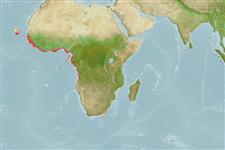
Eastern Atlantic, including the Mediterranean Sea and Ascension Island.
Size / Weight / Age
Maturity: Lm ? range ? - ? cm
Max length : 100.0 cm FL male/unsexed; (Ref. 58464); max. published weight: 26.0 kg (Ref. 58464)
Dorsal
spines
(total): 9;
Dorsal
soft rays
(total): 21-24;
Anal
spines: 3;
Anal
soft rays: 17 - 19;
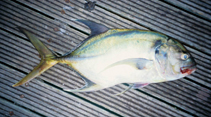
Vertebrae: 24. This species is a member of the Caranx hippos complex, and is distinguished by the following characters: segmented dorsal-fin rays 21-23 (exceptionally 24); segmented anal-fin rays 17-19, usually 18; posttemporal bones are hyperossified in specimens larger than 20 cm FL; cleithrum, first pterygiophore of dorsal and anal fins, and neural spines of vertebrae are relatively slender and never hyperossified; in specimens >20 cm FL, heights of longest dorsal-and anal-fin rays are both 0.7-1.3 in head length; in adults, anal-fin lobe white anteriorly and remainder of fin is gray to brown (Ref. 58464).
This species is reported to occur in moderate to large schools in coastal areas, estuaries and lagoons that are essential habitat for juveniles and young. Reports that it descends far up coastal rivers to spawn are unconfirmed and true freshwater occurrence is doubtful, but there are verified collections of juveniles from three separate coastal river drainages. Feeds mainly on fish, shrimp and other invertebrates. It has been a focus of commercial interest and may be utilized fresh, frozen, smoked, dried-salted and for oil and fishmeal, with edibility reported as poor to good, and taste improves when bleeding upon landing is done (Ref. 109259).
Life cycle and mating behavior
Maturity | Reproduction | Spawning | Eggs | Fecundity | Larvae
Smith-Vaniz, W.F. and K.E. Carpenter, 2007. Review of the crevalle jacks, Caranx hippos complex (Teleostei: Carangidae), with a description of a new species from West Africa. Fish. Bull. 105(2):207-233. (Ref. 58464)
IUCN Red List Status (Ref. 130435)
Threat to humans
Harmless
Human uses
Fisheries:
More information
Common namesSynonymsMetabolismPredatorsEcotoxicologyReproductionMaturitySpawningSpawning aggregationFecundityEggsEgg development
ReferencesAquacultureAquaculture profileStrainsGeneticsElectrophoresesHeritabilityDiseasesProcessingNutrientsMass conversion
Tools
Special reports
Download XML
Internet sources
Estimates based on models
Preferred temperature (Ref.
123201): 16.2 - 25.7, mean 19.7 °C (based on 72 cells).
Phylogenetic diversity index (Ref.
82804): PD
50 = 0.5000 [Uniqueness, from 0.5 = low to 2.0 = high].
Bayesian length-weight: a=0.01738 (0.00796 - 0.03794), b=2.94 (2.77 - 3.11), in cm total length, based on LWR estimates for this Genus-body shape (Ref.
93245).
Trophic level (Ref.
69278): 4.2 ±0.7 se; based on size and trophs of closest relatives
Resilience (Ref.
120179): Low, minimum population doubling time 4.5 - 14 years (Preliminary K or Fecundity.).
Fishing Vulnerability (Ref.
59153): High to very high vulnerability (67 of 100).