Classification / Names
Common names | Synonyms | Catalog of Fishes(genus, species) | ITIS | CoL | WoRMS | Cloffa
Environment: milieu / climate zone / depth range / distribution range
Ecology
Marine; reef-associated; depth range 12 - 100 m (Ref. 90102). Tropical; 34°N - 35°S, 25°E - 170°W
Indo-West Pacific: Red Sea and East Africa to New Caledonia, north to the Ryukyu Islands, south to the Great Barrier Reef. Recently reported from Tonga (Ref. 53797).
Size / Weight / Age
Maturity: Lm ? range ? - ? cm
Max length : 90.0 cm TL male/unsexed; (Ref. 3287); common length : 90.0 cm TL male/unsexed; (Ref. 5450); max. published weight: 14.5 kg (Ref. 3287)
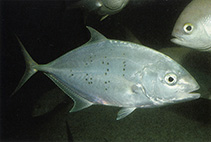
Adults inhabit deep offshore reefs (Ref. 9710, 48635). They are found near corals and rocks. Large individuals are solitary. They feed on shrimp and small fish (Ref. 5213). Juveniles form small schools. Excellent food fish (Ref. 12484). Minimum depth range based on occurrence (Ref. 11897); to be replaced with a better reference.
Life cycle and mating behavior
Maturity | Reproduction | Spawning | Eggs | Fecundity | Larvae
Paxton, J.R., D.F. Hoese, G.R. Allen and J.E. Hanley, 1989. Pisces. Petromyzontidae to Carangidae. Zoological Catalogue of Australia, Vol. 7. Australian Government Publishing Service, Canberra, 665 p. (Ref. 7300)
IUCN Red List Status (Ref. 130435)
Threat to humans
Harmless
Human uses
Fisheries: commercial; gamefish: yes
More information
ReferencesAquacultureAquaculture profileStrainsGeneticsElectrophoresesHeritabilityDiseasesProcessingNutrientsMass conversion
Tools
Special reports
Download XML
Internet sources
Estimates based on models
Preferred temperature (Ref.
123201): 24.9 - 29, mean 27.8 °C (based on 1122 cells).
Phylogenetic diversity index (Ref.
82804): PD
50 = 0.5000 [Uniqueness, from 0.5 = low to 2.0 = high].
Bayesian length-weight: a=0.02344 (0.01496 - 0.03673), b=2.92 (2.79 - 3.05), in cm total length, based on LWR estimates for this species & Genus-body shape (Ref.
93245).
Trophic level (Ref.
69278): 4.1 ±0.72 se; based on food items.
Resilience (Ref.
120179): Medium, minimum population doubling time 1.4 - 4.4 years (Preliminary K or Fecundity.).
Fishing Vulnerability (Ref.
59153): High vulnerability (56 of 100).
Nutrients (Ref.
124155): Calcium = 21.8 [13.8, 42.9] mg/100g; Iron = 1.03 [0.48, 2.00] mg/100g; Protein = 20.3 [17.7, 22.3] %; Omega3 = 0.162 [0.098, 0.275] g/100g; Selenium = 12.1 [6.0, 24.0] μg/100g; VitaminA = 44.6 [8.3, 251.4] μg/100g; Zinc = 0.601 [0.330, 1.339] mg/100g (wet weight);