Elasmobranchii (sharks and rays) >
Carcharhiniformes (Ground sharks) >
Atelomycteridae (Coloured catsharks)
Etymology: Atelomycterus: ateles (Gr.), imperfect, unfilled or exempt; mycteros (Gr.), nostril, referring to lack of posterior nasal valve. (See ETYFish); fasciatus: Latin for banded, referring to slender, brown saddles on a white background. (See ETYFish).
Environment: milieu / climate zone / depth range / distribution range
Ecology
Marine; demersal; depth range 27 - 122 m (Ref. 11146), usually ? - 60 m (Ref. 11146). Tropical; 10°S - 21°S
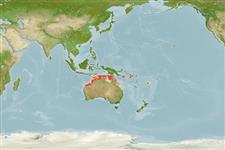
Indo-West Pacific: northern Australia. Western Australian specimens lack the white spots and are lighter colored.
Length at first maturity / Size / Weight / Age
Maturity: Lm 34.5, range 30 - 39 cm
Max length : 45.0 cm TL male/unsexed; (Ref. 11146)
Short description
Morphology | Morphometrics
Dorsal
spines
(total): 0;
Dorsal
soft rays
(total): 0;
Anal
spines: 0;
Anal
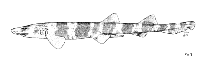
soft rays: 0. Black spots and markings relatively few, small, and scattered, color pattern dominated by greyish saddles and bands on light background (Ref. 11146). Western Australian specimens lack the white spots and are lighter in color (Ref. 11146).
A common offshore catshark found on mud, sand, or shelly-sand bottom (Ref. 11146). Oviparous (Ref. 50449).
Life cycle and mating behavior
Maturity | Reproduction | Spawning | Eggs | Fecundity | Larvae
Oviparous, paired eggs are laid. Embryos feed solely on yolk (Ref. 50449).
Compagno, L.J.V. and V.H. Niem, 1998. Scyliorhinidae. Catsharks. p. 1279-1292. In K.E. Carpenter and V.H. Niem (eds.) FAO Identification Guide for Fishery Purposes. The Living Marine Resources of the Western Central Pacific. FAO, Rome. (Ref. 11146)
IUCN Red List Status (Ref. 130435)
Threat to humans
Harmless
Human uses
More information
Age/SizeGrowthLength-weightLength-lengthLength-frequenciesMorphometricsMorphologyLarvaeLarval dynamicsRecruitmentAbundanceBRUVS
ReferencesAquacultureAquaculture profileStrainsGeneticsElectrophoresesHeritabilityDiseasesProcessingNutrientsMass conversion
Tools
Special reports
Download XML
Internet sources
Estimates based on models
Preferred temperature (Ref.
123201): 25.3 - 28.3, mean 26.6 °C (based on 22 cells).
Phylogenetic diversity index (Ref.
82804): PD
50 = 0.5156 [Uniqueness, from 0.5 = low to 2.0 = high].
Trophic level (Ref.
69278): 3.7 ±0.3 se; based on size and trophs of closest relatives
Resilience (Ref.
120179): Low, minimum population doubling time 4.5 - 14 years (Fec assumed to be <100).
Fishing Vulnerability (Ref.
59153): Low to moderate vulnerability (35 of 100).