Teleostei (teleosts) >
Pleuronectiformes (Flatfishes) >
Bothidae (Lefteye flounders)
Etymology: Asterorhombus: Greek, aster = star + Greek, rhombos = paralelogram (Ref. 45335).
More on author: Bleeker.
Environment: milieu / climate zone / depth range / distribution range
Ecology
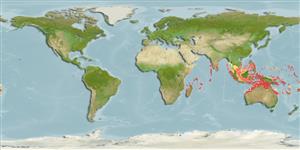
Marine; reef-associated; depth range 1 - 96 m (Ref. 9824). Tropical; 16°N - 24°S
Indo-Pacific: Red Sea to Tonga, north to southern Japan, south to the Indo-Australian Archipelago.
Size / Weight / Age
Maturity: Lm ? range ? - ? cm
Max length : 20.0 cm SL male/unsexed; (Ref. 48637)
Dorsal
spines
(total): 0;
Dorsal
soft rays
(total): 77-84;
Anal
spines: 0;
Anal
soft rays: 55 - 62. Distinguished from all other Micronesian genera by having a nearly continuous bony ridge extending from the anterior margin of the lower eye to the posterior margin of the upper eye, and a narrow interorbital space, always greater than the greatest eye diameter.
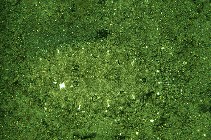
Inhabits sand and mud bottoms. Active during the day (Ref. 48637). Feeds on bottom-living animals. Also caught by divers.
Life cycle and mating behavior
Maturity | Reproduction | Spawning | Eggs | Fecundity | Larvae
Hensley, D.A., 2005. Revision of the genus Asterorhombus (Pleuronectiformes: Bothidae). Copeia 2005(3):445-460. (Ref. 57759)
IUCN Red List Status (Ref. 130435)
Threat to humans
Harmless
Human uses
Fisheries: minor commercial
More information
Common namesSynonymsMetabolismPredatorsEcotoxicologyReproductionMaturitySpawningSpawning aggregationFecundityEggsEgg development
ReferencesAquacultureAquaculture profileStrainsGeneticsElectrophoresesHeritabilityDiseasesProcessingNutrientsMass conversion
Tools
Special reports
Download XML
Internet sources
Estimates based on models
Preferred temperature (Ref.
123201): 25.5 - 28.9, mean 27.8 °C (based on 902 cells).
Phylogenetic diversity index (Ref.
82804): PD
50 = 0.6250 [Uniqueness, from 0.5 = low to 2.0 = high].
Bayesian length-weight: a=0.00871 (0.00445 - 0.01706), b=3.09 (2.92 - 3.26), in cm total length, based on LWR estimates for this species & (Sub)family-body (Ref.
93245).
Trophic level (Ref.
69278): 4.2 ±0.0 se; based on diet studies.
Resilience (Ref.
120179): Medium, minimum population doubling time 1.4 - 4.4 years (Preliminary K or Fecundity.).
Fishing Vulnerability (Ref.
59153): Low vulnerability (14 of 100).
Nutrients (Ref.
124155): Calcium = 63.1 [24.4, 113.1] mg/100g; Iron = 0.577 [0.266, 1.020] mg/100g; Protein = 18.1 [16.6, 19.7] %; Omega3 = 0.0949 [, ] g/100g; Selenium = 28.9 [13.8, 66.7] μg/100g; VitaminA = 160 [39, 649] μg/100g; Zinc = 0.954 [0.603, 1.458] mg/100g (wet weight);