Teleostei (teleosts) >
Eupercaria/misc (Various families in series Eupercaria) >
Haemulidae (Grunts) > Haemulinae
Etymology: Anisotremus: Greek, anisos = unequal + Greek, trema, -atos = hole (Ref. 45335).
More on author: Linnaeus.
Environment: milieu / climate zone / depth range / distribution range
Ecology
Marine; reef-associated; depth range 2 - 70 m (Ref. 9710). Subtropical; 32°N - 33°S, 98°W - 34°W
Western Atlantic: Bermuda (introduced) and Florida, USA to Brazil, including the Gulf of Mexico and the Caribbean Sea (Ref. 9626).
Size / Weight / Age
Maturity: Lm ? range ? - ? cm
Max length : 40.6 cm TL male/unsexed; (Ref. 40637); common length : 25.0 cm TL male/unsexed; (Ref. 3798); max. published weight: 930.00 g (Ref. 40637)
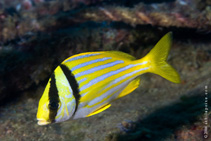
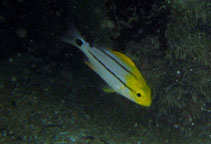
Dorsal spines (total): 12; Dorsal soft rays (total): 16 - 18; Anal spines: 3; Anal soft rays: 9. Body striped yellow and silvery blue; fins yellow, 2 black bars: one from nape through eye to mouth, another from origin of dorsal fin to base of pectoral fin. Only grunt fish in the Caribbean with two vertical black bars and yellow stripes. (Ref. 26938).
Body shape (shape guide): short and / or deep.
Maximum depth from Ref. 126840. Inhabits reefs and rocky bottoms. Feeds at night on mollusks, echinoderms, annelids, and crustaceans (Ref. 3798). Young pick parasites from the bodies of larger fishes (Ref. 5521). Young are popular aquarium fish (Ref. 7251). Marketed fresh (Ref. 3798). Has been reared in captivity (Ref. 35420).
Life cycle and mating behavior
Maturity | Reproduction | Spawning | Eggs | Fecundity | Larvae
Distinct pairing during breeding (Ref. 205).
Robins, C.R. and G.C. Ray, 1986. A field guide to Atlantic coast fishes of North America. Houghton Mifflin Company, Boston, U.S.A. 354 p. (Ref. 7251)
IUCN Red List Status (Ref. 130435: Version 2025-1)
Threat to humans
Reports of ciguatera poisoning (Ref. 30303)
Human uses
Fisheries: minor commercial; gamefish: yes; aquarium: public aquariums
Tools
Special reports
Download XML
Internet sources
Estimates based on models
Preferred temperature (Ref.
123201): 24.9 - 28.2, mean 27.4 °C (based on 791 cells).
Phylogenetic diversity index (Ref.
82804): PD
50 = 0.5020 [Uniqueness, from 0.5 = low to 2.0 = high].
Bayesian length-weight: a=0.01514 (0.00889 - 0.02578), b=3.05 (2.90 - 3.20), in cm total length, based on LWR estimates for this species & (Sub)family-body (Ref.
93245).
Trophic level (Ref.
69278): 3.6 ±0.5 se; based on diet studies.
Resilience (Ref.
120179): Medium, minimum population doubling time 1.4 - 4.4 years (Preliminary K or Fecundity.).
Fishing Vulnerability (Ref.
59153): Low to moderate vulnerability (31 of 100).
🛈
Nutrients (Ref.
124155): Calcium = 22.6 [10.1, 62.8] mg/100g; Iron = 0.538 [0.258, 1.056] mg/100g; Protein = 19.6 [17.7, 21.7] %; Omega3 = 0.144 [0.066, 0.285] g/100g; Selenium = 13.1 [5.8, 27.3] μg/100g; VitaminA = 35.1 [9.5, 131.4] μg/100g; Zinc = 0.673 [0.404, 1.106] mg/100g (wet weight);