Teleostei (teleosts) >
Ovalentaria/misc (Various families in series Ovalentaria) >
Pomacentridae (Damselfishes) > Pomacentrinae
Etymology: Amphiprion: Greek, amphi = on both sides + Greek, prion, -onos = saw (Ref. 45335).
Environment: milieu / climate zone / depth range / distribution range
Ecology
Marine; reef-associated; non-migratory; depth range 3 - 20 m (Ref. 7247). Tropical; 30°N - 25°S
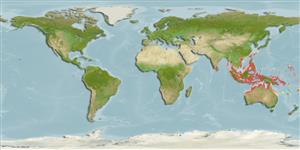
Western Pacific: Christmas Island and Western Australia to the Ryukyu Islands, Taiwan, Philippines, New Guinea, D'Entrecasteaux Islands, New Britain, and Solomon Islands.
Size / Weight / Age
Maturity: Lm ? range ? - ? cm
Max length : 14.0 cm TL male/unsexed; (Ref. 9710)
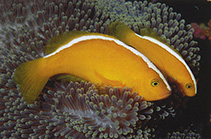
Adults occur in lagoon and outer reefs in pairs and small groups (Ref. 48636). Monogamous (Ref. 55367). A protandrous hermaphrodite (Ref. 32166). Oviparous, distinct pairing during breeding (Ref. 205). Eggs are demersal and adhere to the substrate (Ref. 205). Males guard and aerate the eggs (Ref. 205). Associated with the anemones: Heteractis crispa and Stichodactyla mertensii (Ref. 5911). Have been reared in captivity (Ref. 35413, 35418, 35420).
Life cycle and mating behavior
Maturity | Reproduction | Spawning | Eggs | Fecundity | Larvae
Benthic spawner. Oviparous, distinct pairing during breeding (Ref. 205). Eggs are demersal and adhere to the substrate (Ref. 205). Males guard and aerate the eggs (Ref. 205). Length at sex change = 5.1 cm TL (Ref. 55367). Also Ref. 240, 7471.
Allen, G.R., 1991. Damselfishes of the world. Mergus Publishers, Melle, Germany. 271 p. (Ref. 7247)
IUCN Red List Status (Ref. 130435)
Threat to humans
Harmless
Human uses
Aquarium: commercial
More information
ReferencesAquacultureAquaculture profileStrainsGeneticsElectrophoresesHeritabilityDiseasesProcessingNutrientsMass conversion
Tools
Special reports
Download XML
Internet sources
Estimates based on models
Preferred temperature (Ref.
123201): 27 - 29.3, mean 28.7 °C (based on 1488 cells).
Phylogenetic diversity index (Ref.
82804): PD
50 = 0.5000 [Uniqueness, from 0.5 = low to 2.0 = high].
Bayesian length-weight: a=0.01479 (0.00642 - 0.03409), b=3.00 (2.80 - 3.20), in cm total length, based on LWR estimates for this (Sub)family-body shape (Ref.
93245).
Trophic level (Ref.
69278): 2.7 ±0.30 se; based on food items.
Resilience (Ref.
120179): High, minimum population doubling time less than 15 months (Preliminary K or Fecundity.).
Fishing Vulnerability (Ref.
59153): Low vulnerability (10 of 100).
Nutrients (Ref.
124155): Calcium = 100 [57, 153] mg/100g; Iron = 0.758 [0.485, 1.163] mg/100g; Protein = 18.7 [17.6, 19.6] %; Omega3 = 0.138 [0.091, 0.208] g/100g; Selenium = 22 [13, 38] μg/100g; VitaminA = 122 [43, 348] μg/100g; Zinc = 1.93 [1.38, 2.62] mg/100g (wet weight);