Teleostei (teleosts) >
Ovalentaria/misc (Various families in series Ovalentaria) >
Pomacentridae (Damselfishes) > Pomacentrinae
Etymology: Amphiprion: Greek, amphi = on both sides + Greek, prion, -onos = saw (Ref. 45335).
More on author: Lacepède.
Environment: milieu / climate zone / depth range / distribution range
Ecology
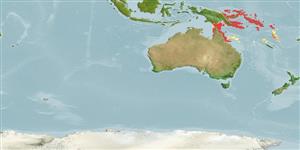
Marine; reef-associated; non-migratory; depth range 1 - 15 m (Ref. 9710). Tropical; 6°S - 26°S, 141°E - 155°E (Ref. 55268)
Western Pacific: Queensland and Melanesia including northern Great Barrier Reef, northern New Guinea, New Britain, Solomon Islands and Vanuatu. Not known from New Caledonia and the Fiji Islands, although Fowler (1959) recorded it from the latter area. Often confused with Amphiprion ocellaris.
Length at first maturity / Size / Weight / Age
Maturity: Lm ?, range 5 - ? cm
Max length : 11.0 cm TL male/unsexed; (Ref. 9710)
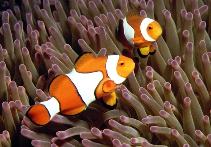
Adults inhabit lagoon and seaward reefs (Ref. 9710). Each group of fish consists of a breeding pair and 0-4 non-breeders. Within each group there is a size-based hierarchy: the female is largest, the male is second largest, and the non-breeders get progressively smaller as the hierarchy is descended. If the female dies, the male changes sex and becomes the breeding female, while the largest non-breeder becomes the breeding male. The maintenance of size differences may avoid conflicts, because subordinates do not become a threat to their dominants (Ref. 47841). Oviparous, distinct pairing during breeding (Ref. 205). Eggs are demersal and adhere to the substrate (Ref. 205). Males guard and aerate the eggs (Ref. 205). Maybe found in shallower depths than A. ocellaris. Associated with the anemones: Heteractis crispa, Heteractis magnifica, and Stichodactyla gigantea (Ref. 5911). This species has been reared in captivity (Ref. 35404, 35413, 35420).
Life cycle and mating behavior
Maturity | Reproduction | Spawning | Eggs | Fecundity | Larvae
Each group of fish consists of a breeding pair and 0-4 non-breeders. Within each group there is a size-based hierarchy: the female is largest, the male is second largest, and the non-breeders get progressively smaller as the hierarchy is desceded. If the female dies, the male changes sex and becomes the breeding female, while the largest non-breeder becomes the breeding male (Ref. 47841). Oviparous, distinct pairing during breeding (Ref. 205). Eggs are demersal and adhere to the substrate (Ref. 205). Males guard and aerate the eggs (Ref. 205). Also Ref. 7471.
Allen, G.R., 1991. Damselfishes of the world. Mergus Publishers, Melle, Germany. 271 p. (Ref. 7247)
IUCN Red List Status (Ref. 130435)
Threat to humans
Harmless
Human uses
Fisheries: of no interest; aquarium: commercial
More information
ReferencesAquacultureAquaculture profileStrainsGeneticsElectrophoresesHeritabilityDiseasesProcessingNutrientsMass conversion
Tools
Special reports
Download XML
Internet sources
Estimates based on models
Preferred temperature (Ref.
123201): 25.5 - 28.4, mean 27.3 °C (based on 198 cells).
Phylogenetic diversity index (Ref.
82804): PD
50 = 0.5000 [Uniqueness, from 0.5 = low to 2.0 = high].
Bayesian length-weight: a=0.01479 (0.00642 - 0.03409), b=3.00 (2.80 - 3.20), in cm total length, based on LWR estimates for this (Sub)family-body shape (Ref.
93245).
Trophic level (Ref.
69278): 2.7 ±0.3 se; based on size and trophs of closest relatives
Resilience (Ref.
120179): High, minimum population doubling time less than 15 months (Preliminary K or Fecundity.).
Fishing Vulnerability (Ref.
59153): Low vulnerability (10 of 100).
Nutrients (Ref.
124155): Calcium = 123 [67, 201] mg/100g; Iron = 0.844 [0.521, 1.333] mg/100g; Protein = 18.5 [17.4, 19.5] %; Omega3 = 0.134 [0.083, 0.212] g/100g; Selenium = 20.7 [12.1, 37.7] μg/100g; VitaminA = 126 [41, 390] μg/100g; Zinc = 2.28 [1.58, 3.16] mg/100g (wet weight);