Teleostei (teleosts) >
Ovalentaria/misc (Various families in series Ovalentaria) >
Pomacentridae (Damselfishes) > Pomacentrinae
Etymology: Amphiprion: Greek, amphi = on both sides + Greek, prion, -onos = saw (Ref. 45335); pacificus: Named for its Pacific Ocean distribution..
Environment: milieu / climate zone / depth range / distribution range
Ecology
Marine; reef-associated; depth range 4 - 10 m (Ref. 85065). Tropical
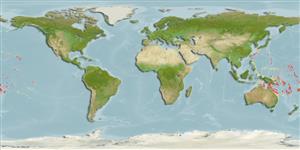
Pacific: Wallis Island, Tonga, Fiji and American Samoa.
Size / Weight / Age
Maturity: Lm ? range ? - ? cm
Max length : 4.8 cm SL male/unsexed; (Ref. 85065)
Short description
Morphology | Morphometrics
Dorsal
spines
(total): 9;
Dorsal
soft rays
(total): 18-20;
Anal
spines: 2;
Anal
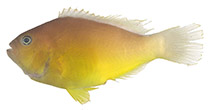
soft rays: 12 - 13. This species is distinguished by the following set of characters: D IX,18-20; A II,12-13; pectoral rays 17-18; tubed lateral line scales 33-48; gill rakers 5-6 + 11-12; opercular spinules 8-11; body depth 2.2-2.6 in SL; color generally pinkish brown, usually grading to yellowish or orange on lower side of body including abdomen; white stripe on midline of snout extending posteriorly on forehead and along base of dorsal fin; fins whitish to semi-translucent (Ref. 85605).
This species is generally commensal with the anemone Heteractis magnificus (Quoy & Gaimard, 1833) at depths between about 4-10 m (Ref. 85065). Oviparous, distinct pairing during breeding (Ref. 205). Eggs are demersal and adhere to the substrate (Ref. 205). Males guard and aerate the eggs (Ref. 205).
Life cycle and mating behavior
Maturity | Reproduction | Spawning | Eggs | Fecundity | Larvae
Oviparous, distinct pairing during breeding (Ref. 205). Eggs are demersal and adhere to the substrate (Ref. 205). Males guard and aerate the eggs (Ref. 205).
Allen, G.R., J. Drew and D. Fenner, 2010. Amphiprion pacificus, a new species of anemonefish (Pomacentridae) from Fiji, Tonga, Samoa, and Wallis Island. aqua, Int. J. Ichthyol. 16(3):129-138. (Ref. 85065)
IUCN Red List Status (Ref. 130435)
Threat to humans
Harmless
Human uses
More information
Age/SizeGrowthLength-weightLength-lengthLength-frequenciesMorphometricsMorphologyLarvaeLarval dynamicsRecruitmentAbundanceBRUVS
ReferencesAquacultureAquaculture profileStrainsGeneticsElectrophoresesHeritabilityDiseasesProcessingNutrientsMass conversion
Tools
Special reports
Download XML
Internet sources
Estimates based on models
Preferred temperature (Ref.
123201): 25.2 - 29.4, mean 27.6 °C (based on 704 cells).
Phylogenetic diversity index (Ref.
82804): PD
50 = 0.5000 [Uniqueness, from 0.5 = low to 2.0 = high].
Bayesian length-weight: a=0.01479 (0.00642 - 0.03409), b=3.00 (2.80 - 3.20), in cm total length, based on LWR estimates for this (Sub)family-body shape (Ref.
93245).
Trophic level (Ref.
69278): 2.8 ±0.3 se; based on size and trophs of closest relatives
Resilience (Ref.
120179): High, minimum population doubling time less than 15 months (Preliminary K or Fecundity.).
Fishing Vulnerability (Ref.
59153): Low vulnerability (10 of 100).