Teleostei (teleosts) >
Siluriformes (Catfishes) >
Amphiliidae (Loach catfishes) > Leptoglaninae
Etymology: Zaireichthys: Composed form Zaire river + Greek,ichtys = fish; the habitat of this fish (Ref. 45335).
More on author: Hilgendorf.
Environment: milieu / climate zone / depth range / distribution range
Ecology
Freshwater; demersal; dH range: 20 - ?. Tropical; 22°C - 25°C (Ref. 2059); 11°S - 22°S
Africa: Lake Victoria, Rufiji and Lake Rukwa systems (Ref. 78218), questionably in Tana River in Kenya (Ref. 52331). Also in Okavango, Zambezi, Pungwe, Buzi, Save systems as well as in the Lake Malawi catchment (Ref. 7248). Presence in the Congo basin questionable (Ref. 51287, 58032, 78218). As it currently stands, this species probably represents a complex of several different species (Ref. 7248).
Size / Weight / Age
Maturity: Lm ? range ? - ? cm
Max length : 3.8 cm SL male/unsexed; (Ref. 51287)
Dorsal
spines
(total): 2;
Dorsal
soft rays
(total): 5-6;
Anal
spines: 0;
Anal
soft rays: 11 - 13;
Vertebrae: 35 - 38. Diagnosis: This species differs from Zaireichthys lacustris and Z. maravensis in possessing a premaxillary tooth patch that is less than 40% of the mouth width; it has shorter barbels than Z. wamiensis, maxillary barbel 0.9-1.3 in head length vs. 0.7-0.9; and it is distinguished from Z. compactus by higher number of branched pectoral-fin rays, 7 vs. 6 (Ref. 86935).
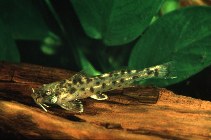
Inhabits fairly shallow water (Ref. 13337). Occurs over sand, usually buried with just the eyes protruding. Feeds on minute organisms. Eggs few (12-16) and large (3-5 mm diameter) suggesting possible parental care (Ref. 7248).
Life cycle and mating behavior
Maturity | Reproduction | Spawning | Eggs | Fecundity | Larvae
Roberts, T.R., 2003. Systematics and osteology of Leptoglaninae a new subfamily of the African catfish family Amphiliidae, with descriptions of three new genera and six new species. Proc. Calif. Acad. Sci. 54(5):81-132. (Ref. 51287)
IUCN Red List Status (Ref. 130435)
Threat to humans
Harmless
Human uses
Fisheries: of potential interest; aquarium: potential
More information
Common namesSynonymsMetabolismPredatorsEcotoxicologyReproductionMaturitySpawningSpawning aggregationFecundityEggsEgg development
ReferencesAquacultureAquaculture profileStrainsGeneticsElectrophoresesHeritabilityDiseasesProcessingNutrientsMass conversion
Tools
Special reports
Download XML
Internet sources
Estimates based on models
Phylogenetic diversity index (Ref.
82804): PD
50 = 0.5000 [Uniqueness, from 0.5 = low to 2.0 = high].
Bayesian length-weight: a=0.00389 (0.00180 - 0.00842), b=3.12 (2.94 - 3.30), in cm total length, based on all LWR estimates for this body shape (Ref.
93245).
Trophic level (Ref.
69278): 3.4 ±0.45 se; based on food items.
Resilience (Ref.
120179): High, minimum population doubling time less than 15 months (Preliminary K or Fecundity.).
Fishing Vulnerability (Ref.
59153): Low vulnerability (10 of 100).