Teleostei (teleosts) >
Ophidiiformes (Cusk eels) >
Ophidiidae (Cusk-eels) > Neobythitinae
Etymology: Dicrolene: Greek, dikros = with two ends + Greek, lenos , ou = cavity in the skull (Ref. 45335).
More on authors: Hureau & Nielsen.
Environment: milieu / climate zone / depth range / distribution range
Ecology
Marine; bathydemersal; depth range 2772 - 2992 m (Ref. 3686). Deep-water
Eastern Atlantic: known only from off Namibia.
Size / Weight / Age
Maturity: Lm ? range ? - ? cm
Max length : 16.6 cm SL male/unsexed; (Ref. 3686)
Short description
Morphology | Morphometrics
Dorsal
spines
(total): 0;
Dorsal
soft rays
(total): 112-118;
Anal
spines: 0;
Anal
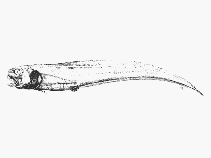
soft rays: 89 - 94. Snout rather blunt; eye diameter almost as long as snout; opercular spine strong and straight; hind margin of preopercle usually with 3 sharp spines; 1 median (broad) and a pair (larger and overlapping median one) of basibranchial tooth patches; pseudobranchial filaments 2 or 3; 7-15 developed rakers on anterior arch; lower 5-11 pectoral fin rays free and longer than upper ones; precaudal vertebrae 13-16 (Ref. 34024). No black fin rays; spines in supraorbital absent and on preopercle absent or weak (Ref. 34024).
Rare species (Ref. 34024). Reproductive strategy possibly similar to other members of this family featuring oviparity, with oval pelagic eggs floating in a gelatinous mass (Ref. 205).
Life cycle and mating behavior
Maturity | Reproduction | Spawning | Eggs | Fecundity | Larvae
Nielsen, J.G., D.M. Cohen, D.F. Markle and C.R. Robins, 1999. Ophidiiform fishes of the world (Order Ophidiiformes). An annotated and illustrated catalogue of pearlfishes, cusk-eels, brotulas and other ophidiiform fishes known to date. FAO Fish. Synop. 125(18):178p. Rome: FAO. (Ref. 34024)
IUCN Red List Status (Ref. 130435)
Threat to humans
Harmless
Human uses
Fisheries: of no interest
More information
Common namesSynonymsMetabolismPredatorsEcotoxicologyReproductionMaturitySpawningSpawning aggregationFecundityEggsEgg development
Age/SizeGrowthLength-weightLength-lengthLength-frequenciesMorphometricsMorphologyLarvaeLarval dynamicsRecruitmentAbundanceBRUVS
ReferencesAquacultureAquaculture profileStrainsGeneticsElectrophoresesHeritabilityDiseasesProcessingNutrientsMass conversion
Tools
Special reports
Download XML
Internet sources
Estimates based on models
Preferred temperature (Ref.
123201): 2.4 - 3.2, mean 2.6 °C (based on 18 cells).
Phylogenetic diversity index (Ref.
82804): PD
50 = 0.5000 [Uniqueness, from 0.5 = low to 2.0 = high].
Bayesian length-weight: a=0.00110 (0.00041 - 0.00296), b=3.08 (2.85 - 3.31), in cm total length, based on LWR estimates for this (Sub)family-body shape (Ref.
93245).
Trophic level (Ref.
69278): 3.5 ±0.6 se; based on size and trophs of closest relatives
Resilience (Ref.
120179): Medium, minimum population doubling time 1.4 - 4.4 years (Assuming tmax>3).
Fishing Vulnerability (Ref.
59153): Low vulnerability (10 of 100).