Elasmobranchii (sharks and rays) >
Carcharhiniformes (Ground sharks) >
Carcharhinidae (Requiem sharks)
Etymology: Carcharhinus: karcharos (Gr.), sharp or jagged; rhinus, an ancient name for sharks, from rhine (Gr.), rasp, both words alluding to a shark's jagged, rasp-like skin. (See ETYFish); limbatus: Latin for edged or bordered, referring to black-edged fins [authorship often attributed to Müller & Henle, who published Valenciennes’ description]. (See ETYFish).
Environment: milieu / climate zone / depth range / distribution range
Ecology
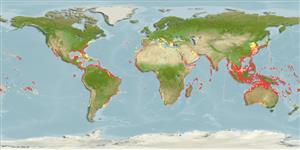
Marine; brackish; reef-associated; amphidromous (Ref. 51243); depth range 0 - 140 m (Ref. 106604), usually 0 - 30 m (Ref. 55184). Subtropical; 45°N - 38°S, 180°W - 180°E (Ref. 55184)
Cosmopolitan. Western Atlantic: Nova Scotia, Canada to Brazil (Ref. 26340). Eastern Atlantic: Senegal to Democratic Republic of the Congo, Madeira, the Canary Islands, and Mediterranean (Ref. 244). Indo-Pacific: Persian Gulf (Ref. 68964), Red Sea, Madagascar and South Africa to China, Australia, Tahiti, Marquesas, and Hawaii. Eastern Pacific: Baja California, Mexico to Peru, including the Galapagos Islands.
Length at first maturity / Size / Weight / Age
Maturity: Lm 165.4, range 120 - 194 cm
Max length : 286 cm TL male/unsexed; (Ref. 106604); common length : 150 cm TL male/unsexed; (Ref. 9253); max. published weight: 122.8 kg (Ref. 4699); max. reported age: 12 years (Ref. 244)
Dorsal
spines
(total): 0;
Dorsal
soft rays
(total): 0;
Anal
spines: 0;
Anal
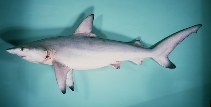
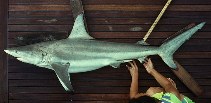
soft rays: 0. A stout shark with a long, narrow, pointed snout, long gill slits and erect, narrow-cusped upper teeth; first dorsal fin high; no interdorsal ridge (Ref. 5578). Dark grey, ashy blue or dusky bronze on back, belly white or yellowish white; a dark band extending rearward along each side to about over origin of pelvic fin; tips of pelvic fins with a persistent black spot; tips of dorsal fins, pectoral fins, anal, and lower lobe of caudal fin usually black or dusky in young individuals, fading with growth (Ref. 9997).
An inshore and offshore shark found on or adjacent to continental and insular shelves (Ref. 244). Often off river mouths and estuaries, muddy bays, mangrove swamps, lagoons, and coral reef drop-offs (Ref. 244). Bottom associated or pelagic (Ref. 58302). Young common along beaches (Ref. 9710). Active hunter in midwater (Ref. 5485). Feeds mainly on pelagic and benthic fishes, also small sharks and rays, cephalopods and crustaceans (Ref. 5578; 37816). Viviparous (Ref. 50449). Produces litters of one to 10 young (Ref. 26938, 1602). Incriminated in very few attacks but dangerous when provoked (Ref. 244). Often taken by shore anglers (Ref. 5485). Used fresh for human consumption, hides for leather, liver for oil (Ref. 244). Parthenogenesis has been observed in a captive female (Ref. 80664).
Distinct pairing with embrace (Ref. 205). Viviparous, with a yolk-sac placenta, 1 to 10 young per litter. Gestation period is 10 to 12 months. Nursery and pupping grounds are located inshore where pregnant females go to drop their young. Females are thought to spawn only every two years. Size at birth 38-72 cm (Ref. 244); 55-66 cm TL (Ref.58048).
Compagno, L.J.V., 1984. FAO Species Catalogue. Vol. 4. Sharks of the world. An annotated and illustrated catalogue of shark species known to date. Part 2 - Carcharhiniformes. FAO Fish. Synop. 125(4/2):251-655. Rome: FAO. (Ref. 244)
IUCN Red List Status (Ref. 130435)
Human uses
Fisheries: commercial; gamefish: yes
Tools
Special reports
Download XML
Internet sources
Estimates based on models
Preferred temperature (Ref.
123201): 19.9 - 29, mean 27.4 °C (based on 3336 cells).
Phylogenetic diversity index (Ref.
82804): PD
50 = 0.5000 [Uniqueness, from 0.5 = low to 2.0 = high].
Bayesian length-weight: a=0.00468 (0.00396 - 0.00553), b=3.08 (3.04 - 3.12), in cm total length, based on LWR estimates for this species (Ref.
93245).
Trophic level (Ref.
69278): 4.4 ±0.4 se; based on diet studies.
Resilience (Ref.
120179): Low, minimum population doubling time 4.5 - 14 years (rm=0.054; K=0.27; tm=3-8; tmax=18; Fec=1-10).
Prior r = 0.30, 95% CL = 0.19 - 0.48, Based on 1 stock assessment.
Fishing Vulnerability (Ref.
59153): High vulnerability (55 of 100).
Climate Vulnerability (Ref.
125649): Very high vulnerability (79 of 100).
Nutrients (Ref.
124155): Calcium = 4.26 [0.72, 22.52] mg/100g; Iron = 0.385 [0.093, 1.176] mg/100g; Protein = 23.4 [20.6, 25.6] %; Omega3 = 0.178 [0.063, 0.455] g/100g; Selenium = 15.8 [4.5, 48.0] μg/100g; VitaminA = 20.6 [5.9, 72.3] μg/100g; Zinc = 0.358 [0.169, 0.728] mg/100g (wet weight); based on
nutrient studies.