Teleostei (teleosts) >
Kurtiformes (Nurseryfishes, cardinalfishes.) >
Apogonidae (Cardinalfishes) > Apogoninae
Etymology: More on author: Cuvier.
Environment: milieu / climate zone / depth range / distribution range
Ecology
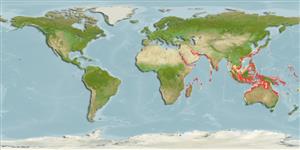
Marine; reef-associated; depth range 1 - 50 m (Ref. 43448). Subtropical; 31°N - 34°S, 32°E - 155°E
Indo-West Pacific. Red Sea, east to Indonesia and south to Delagoa Bay, Mozambique (Ref. 4329) and Australia. Also occurs in the Arafura Sea (Ref. 9819), Persian Gulf (Ref. 68964) and Seychelles (Ref. 1623).
Size / Weight / Age
Maturity: Lm ? range ? - ? cm
Max length : 10.0 cm TL male/unsexed; (Ref. 4329)
Dorsal
spines
(total): 8;
Dorsal
soft rays
(total): 8-9;
Anal
spines: 2;
Anal
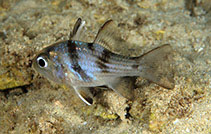
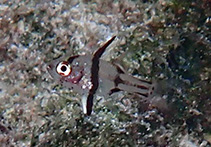
soft rays: 7 - 8. Dark vertical bar present below each dorsal fin and on caudal base; a fourth bar may be present between the 2nd dorsal and the caudal base; normally with large ocellus above pectoral fins; pelvic fins black, pectoral fins light, other fins dusky to dark in color (Ref. 4329).
Adults occur inshore (Ref. 7300) and in deep offshore reefs (Ref. 9710). Found among weeds (Ref. 1623). Nocturnal species. Feed at night on zooplankton (Ref. 43448). Have been reared in captivity (Ref. 35416). Mouthbrooders, the males incubate the eggs (Ref. 43448).
Life cycle and mating behavior
Maturity | Reproduction | Spawning | Eggs | Fecundity | Larvae
Mouthbrooders (Ref. 240). Distinct pairing during courtship and spawning (Ref. 205).
Gon, O., 1986. Apogonidae. p. 546-561. In M.M. Smith and P.C. Heemstra (eds.) Smiths' sea fishes. Springer-Verlag, Berlin. (Ref. 4329)
IUCN Red List Status (Ref. 130435)
Threat to humans
Harmless
Human uses
More information
ReferencesAquacultureAquaculture profileStrainsGeneticsElectrophoresesHeritabilityDiseasesProcessingNutrientsMass conversion
Tools
Special reports
Download XML
Internet sources
Estimates based on models
Preferred temperature (Ref.
123201): 24 - 29.1, mean 27.6 °C (based on 824 cells).
Phylogenetic diversity index (Ref.
82804): PD
50 = 0.5000 [Uniqueness, from 0.5 = low to 2.0 = high].
Bayesian length-weight: a=0.01514 (0.00909 - 0.02520), b=2.98 (2.84 - 3.12), in cm total length, based on LWR estimates for this species & (Sub)family-body (Ref.
93245).
Trophic level (Ref.
69278): 3.4 ±0.50 se; based on food items.
Resilience (Ref.
120179): High, minimum population doubling time less than 15 months (Preliminary K or Fecundity.).
Fishing Vulnerability (Ref.
59153): Low vulnerability (10 of 100).
Nutrients (Ref.
124155): Calcium = 88.9 [40.4, 184.8] mg/100g; Iron = 0.98 [0.51, 1.91] mg/100g; Protein = 19.3 [18.0, 20.5] %; Omega3 = 0.203 [0.101, 0.412] g/100g; Selenium = 16.5 [6.8, 36.5] μg/100g; VitaminA = 34.5 [8.0, 150.7] μg/100g; Zinc = 1.17 [0.69, 1.86] mg/100g (wet weight);