Teleostei (teleosts) >
Blenniiformes (Blennies) >
Blenniidae (Combtooth blennies) > Blenniinae
Etymology: Meiacanthus: Greek, meion = less = lessen + Greek, akantha = thorn (Ref. 45335).
Environment: milieu / climate zone / depth range / distribution range
Ecology
Marine; reef-associated; depth range 1 - 20 m (Ref. 48636). Tropical
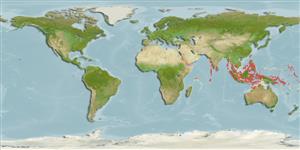
Indo-West Pacific: northern Sri Lanka, and western Java Sea. Reported from southeast India (Ref. 9710).
Size / Weight / Age
Maturity: Lm ? range ? - ? cm
Max length : 8.5 cm TL male/unsexed; (Ref. 2272)
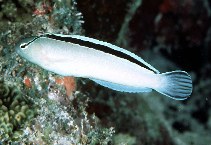
Similar to M. atrodorsalis, but lacks yellow and black lines from eye and along dorsal fin are longer and thicker (Ref. 48636).
Adults occur in coastal and inner reef habitats to about 20 m depth (Ref. 48636). Juveniles usually found solitary and adults occasionally in pairs (Ref. 48636, 90102). Oviparous. Eggs are demersal and adhesive (Ref. 205), and are attached to the substrate via a filamentous, adhesive pad or pedestal (Ref. 94114). Larvae are planktonic, often found in shallow, coastal waters (Ref. 94114). Sexual dimorphism present. and young Scolopsis biliniatus are mimics (Ref. 90102). Minimum depth reported from Ref. 90102.
Life cycle and mating behavior
Maturity | Reproduction | Spawning | Eggs | Fecundity | Larvae
Oviparous, distinct pairing (Ref. 205).
Smith-Vaniz, W.F., 1987. The saber-toothed blennies, tribe Nemophini (Pisces: Bleniidae): an update. Proc. Acad. Nat. Sci. Philad. 139:1-52. (Ref. 7401)
IUCN Red List Status (Ref. 130435)
Threat to humans
Harmless
Human uses
Aquarium: commercial
More information
ReferencesAquacultureAquaculture profileStrainsGeneticsElectrophoresesHeritabilityDiseasesProcessingNutrientsMass conversion
Tools
Special reports
Download XML
Internet sources
Estimates based on models
Preferred temperature (Ref.
123201): 28.1 - 29.3, mean 28.8 °C (based on 1810 cells).
Phylogenetic diversity index (Ref.
82804): PD
50 = 0.5000 [Uniqueness, from 0.5 = low to 2.0 = high].
Bayesian length-weight: a=0.00562 (0.00258 - 0.01228), b=3.06 (2.87 - 3.25), in cm total length, based on LWR estimates for this (Sub)family-body shape (Ref.
93245).
Trophic level (Ref.
69278): 3.4 ±0.4 se; based on size and trophs of closest relatives
Resilience (Ref.
120179): High, minimum population doubling time less than 15 months (Preliminary K or Fecundity.).
Fishing Vulnerability (Ref.
59153): Low vulnerability (10 of 100).
Nutrients (Ref.
124155): Calcium = 166 [85, 309] mg/100g; Iron = 0.984 [0.575, 1.734] mg/100g; Protein = 17.9 [16.7, 19.0] %; Omega3 = 0.093 [0.049, 0.173] g/100g; Selenium = 23.2 [10.9, 54.5] μg/100g; VitaminA = 193 [57, 708] μg/100g; Zinc = 2.22 [1.46, 3.25] mg/100g (wet weight);