Hyporhamphus affinis  (Günther, 1866)

Tropical halfbeak
Add your observation in Fish Watcher
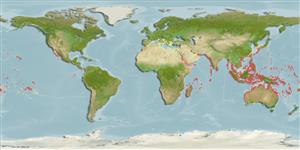
| Native range | All suitable habitat | PointMap | Year 2050 |
This map was computer-generated and has not yet been reviewed.
Hyporhamphus affinis   AquaMaps   Data sources: GBIF OBIS
Upload your photos and videos
Pictures | Google image
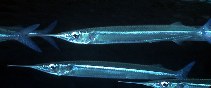
Image of Hyporhamphus affinis (Tropical halfbeak)
Hyporhamphus affinis
Picture by Randall, J.E.

Classification / Names Common names | Synonyms | Catalog of Fishes (gen., sp.) | ITIS | CoL | WoRMS | Cloffa

Actinopterygii (ray-finned fishes) > Beloniformes (Needle fishes) > Hemiramphidae (Halfbeaks)
Etymology: Hyporhamphus: Greek, hypo = under + Greek, rhamphos = beak, bill (Ref. 45335).

Environment / Climate / Range Ecology

Marine; reef-associated.   Tropical

Length at first maturity / Size / Weight / Age

Maturity: Lm ?, range 13 - ? cm
Max length : 38.0 cm SL male/unsexed; (Ref. 54980)

Short description Morphology | Morphometrics

Dorsal spines (total): 0; Dorsal soft rays (total): 14-17; Anal spines: 0; Anal soft rays: 15 - 19; Vertebrae: 54 - 59. Body deep blue above, silvery stripe on side, silvery white below; caudal fin bluish, other fins unpigmented; tip and distal half of underside of lower jaw bright carmine red (Ref. 4164).

Distribution Countries | FAO areas | Ecosystems | Occurrences | Introductions | Faunafri

Indo-Pacific: Red Sea and East Africa through the Indian Ocean islands to western Australia, New Guinea, Philippines, and islands of Oceania. Not found in Hawaiian islands, and apparently absent from Indo-Malayan Archipelago. Has been mentioned in the literature under other names, particularly Hyporhamphus erythrorinchus and Hyporhamphus dussumieri (Ref. 10943).

Biology     Glossary (e.g. epibenthic)

Found chiefly around coral reefs (Ref. 58534) and islands but extends a little further from shore than Hyporhamphus (R.) dussumieri which has a similar range (Ref. 10943). Found in schools (Ref. 9710). Feeds on zooplankton and floating matter. Eggs covered with adhesive filaments to assist in attaching to floating and benthic objects (Ref. 43448).

Main reference Upload your references | References | Coordinator : Collette, Bruce B. | Collaborators

Collette, B.B. and J. Su, 1986. The halfbeaks (Pisces, Beloniformes, Hemiramphidae) of the Far East. Proc. Acad. Nat. Sci. Philadelphia 138(1):250-301.

IUCN Red List Status (Ref. 90363)

Threat to humans

  Harmless


Human uses

FAO(Publication : search) | FisheriesWiki | Sea Around Us

More information

Common names
Synonyms
Metabolism
Predators
Ecotoxicology
Reproduction
Maturity
Spawning
Fecundity
Eggs
Egg development
Age/Size
Growth
Length-weight
Length-length
Length-frequencies
Morphometrics
Morphology
Larvae
Larval dynamics
Recruitment
Abundance
References
Aquaculture
Aquaculture profile
Strains
Genetics
Allele frequencies
Heritability
Diseases
Processing
Mass conversion
Collaborators
Pictures
Stamps, Coins
Sounds
Ciguatera
Speed
Swim. type
Gill area
Otoliths
Brains
Vision

Tools

Special reports

Download XML

Internet sources

Alien/Invasive Species database | BHL | Cloffa | BOLDSystems | Websites from users | Check FishWatcher | CISTI | Catalog of Fishes (gen., sp.) | DiscoverLife | Faunafri | Fishtrace | GenBank(genome, nucleotide) | GOBASE | Google Books | Google Scholar | Google | IGFA World Record | iSpecies | National databases | PubMed | Scirus | SeaLifeBase | Tree of Life | uBio | Wikipedia(Go, Search) | World Records Freshwater Fishing | Zoological Record

Estimates of some properties based on empirical models

Phylogenetic diversity index (Ref. 82805):  PD50 = 0.5000   [Uniqueness, from 0.5 = low to 2.0 = high].
Bayesian length-weight: a=0.00000 (0.00000 - 0.00000), b=0.00 (0.00 - 0.00), based on (Ref. 93245).
Trophic Level (Ref. 69278):  3.5   ±0.48 se; Based on food items.
Resilience (Ref. 69278):  High, minimum population doubling time less than 15 months (Preliminary K or Fecundity.).
Vulnerability (Ref. 59153):  Low to moderate vulnerability (30 of 100) .
Price category (Ref. 80766):   Unknown.