Actinopterygii (ray-finned fishes) >
Perciformes (Perch-likes) >
Blenniidae (Combtooth blennies) > Salariinae
Etymology: Ecsenius: Greek, exenios, -os, -on = uncontrolled, immoderate.
Environment / Climate / Range
Ecology
Marine; reef-associated; depth range 1 - 28 m (Ref. 5296). Tropical
Size / Weight / Age
Maturity: Lm ?  range ? - ? cm
Max length : 9.0 cm TL male/unsexed; (Ref. 559)
Dorsal
spines
(total): 12;
Dorsal
soft rays
(total): 17-18;
Anal
spines: 2;
Anal
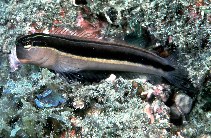
soft rays: 19 - 20. Anterior nostril with a long cirrus on posterior margin only. A longitudinal dark stripe on body often interrupted in larger specimens. In some populations, the black lateral stripe is sometimes present as a series of blotches (not observed in Indonesia) (Ref. 48636).
Indo-West Pacific: Yemen (Ref. 54476) to northwest Australia, Philippines and Japan.
Inhabits shallow clear coastal to outer reef crests with rich coral growth to about 15 m depth (Ref. 48636). Occur in coral reefs (Ref. 9710). Often collected at depths less than 1 m in the northernmost parts of its range, but may occur more deeply (to 28 m) further south, and rarely more shallow than 5 m (Ref. 5296). Oviparous (Ref. 205). Eggs are demersal and adhesive (Ref. 205).
Springer, V.G., 1988. The Indo-Pacific blenniid fish genus Ecsenius. Smithson. Contrib. Zool. (465):134 p.
IUCN Red List Status (Ref. 90363)
Threat to humans
Harmless
Human uses
More information
ReferencesAquacultureAquaculture profileStrainsGeneticsAllele frequenciesHeritabilityDiseasesProcessingMass conversion
CollaboratorsPicturesStamps, CoinsSoundsCiguateraSpeedSwim. typeGill areaOtolithsBrainsVision
Tools
Special reports
Download XML
Internet sources
Estimates of some properties based on empirical models
Phylogenetic diversity index (Ref.
82805): PD
50 = 0.5000 [Uniqueness, from 0.5 = low to 2.0 = high].
Bayesian length-weight: a=0.01107 (-0.15957 - 0.18170), b=2.97 (2.88 - 3.07), based on LWR estimates for this family-BS (Ref.
93245).
Trophic Level (Ref.
69278): 2.0 ±0.00 se; Based on food items.
Resilience (Ref.
69278): High, minimum population doubling time less than 15 months (Preliminary K or Fecundity.).
Vulnerability (Ref.
59153): Low vulnerability (19 of 100) .