Elasmobranchii (sharks and rays) >
Squaliformes (Sleeper and dogfish sharks) >
Somniosidae (Sleeper sharks)
Etymology: Zameus: zame, Japanese for shark (at the time, Z. squamulosus was known only from Japan). (See ETYFish); squamulosus: Latin for covered or beset with small scales, “so minute as to give a velvety appearance to the skin”. (See ETYFish).
More on author: Günther.
Environment: milieu / climate zone / depth range / distribution range
Ecology
Marine; benthopelagic; depth range 0 - 2200 m (Ref. 6871), usually 400 - 900 m (Ref. 55584). Deep-water; 68°N - 56°S, 180°W - 180°E
Atlantic, Indian and Pacific tropical oceans.
Length at first maturity / Size / Weight / Age
Maturity: Lm ?, range 59 - ? cm
Max length : 84.0 cm TL male/unsexed; (Ref. 6871)
Dorsal
spines
(total): 2;
Dorsal
soft rays
(total): 0;
Anal
spines: 0;
Anal
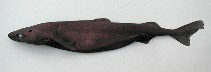
soft rays: 0. Black in color, small dorsal fin spines, moderately long snout, small lanceolate teeth without cusplets in upper jaw and large high, knife-cusped cutting teeth in lower jaw, mouth moderately wide and nearly transverse, caudal fin with strong subterminal notch and short lower lobe (Ref. 247).
Demersal or pelagic near continental slopes and seamounts in depths of 550-2,000 m (Ref. 6871, 58302). Also found from the surface to 580 m over deep water (Ref. 26346). Ovoviviparous (Ref. 205). Used dried and salted for human consumption and for fishmeal (Ref. 6871). Caught rarely by longline fisheries operating in deepwater; also caught, but rarely landed, by pelagic tuna longline fisheries (Ref.58048).
Life cycle and mating behavior
Maturity | Reproduction | Spawning | Eggs | Fecundity | Larvae
Distinct pairing with embrace (Ref. 205). Presumambly viviparous, with yolk-sac dependancy (Ref.58048).
Compagno, L.J.V., 1984. FAO Species Catalogue. Vol. 4. Sharks of the world. An annotated and illustrated catalogue of shark species known to date. Part 1 - Hexanchiformes to Lamniformes. FAO Fish. Synop. 125(4/1):1-249. Rome, FAO. (Ref. 247)
IUCN Red List Status (Ref. 130435)
Threat to humans
Harmless
Human uses
Fisheries: minor commercial
More information
ReferencesAquacultureAquaculture profileStrainsGeneticsElectrophoresesHeritabilityDiseasesProcessingNutrientsMass conversion
Tools
Special reports
Download XML
Internet sources
Estimates based on models
Preferred temperature (Ref.
123201): 4.1 - 12.6, mean 7.7 °C (based on 948 cells).
Phylogenetic diversity index (Ref.
82804): PD
50 = 1.0000 [Uniqueness, from 0.5 = low to 2.0 = high].
Bayesian length-weight: a=0.00389 (0.00168 - 0.00901), b=3.13 (2.94 - 3.32), in cm total length, based on LWR estimates for this (Sub)family-body shape (Ref.
93245).
Trophic level (Ref.
69278): 4.0 ±0.60 se; based on food items.
Resilience (Ref.
120179): Low, minimum population doubling time 4.5 - 14 years (Fec assumed to be <100).
Fishing Vulnerability (Ref.
59153): Moderate to high vulnerability (54 of 100).
Nutrients (Ref.
124155): Calcium = 5.01 [0.96, 26.10] mg/100g; Iron = 0.208 [0.047, 0.710] mg/100g; Protein = 18.7 [16.3, 21.1] %; Omega3 = 0.3 [0.1, 1.0] g/100g; Selenium = 20.2 [5.1, 67.9] μg/100g; VitaminA = 15.5 [2.9, 85.2] μg/100g; Zinc = 0.398 [0.181, 0.835] mg/100g (wet weight);