Issue
The spelling of the genus is C*h*romileptes in Eschmeyer (CofF ver. Mar. 2011: Ref. 86697). Although it is a logical change, it needs further inverstigations because of the general usage of C**romileptes.
Environment: milieu / climate zone / depth range / distribution range
Ecology
Marine; reef-associated; depth range 2 - 40 m (Ref. 9710), usually 5 - 25 m (Ref. 90102). Tropical; 32°N - 23°S, 88°E - 170°E (Ref. 5222)
Western Pacific: southern Japan to Palau, Guam, New Caledonia and southern Queensland, Australia. Eastern Indian Ocean: Nicobar Islands to Broome, Western Australia. Reports from western Indian Ocean (Heemstra and Randall 1984, 1986, Ref. 3153 and 4319 respectively) are unsubstantiated, except one from Kenya (Smith 1954, Ref. 6514) which seems valid. Records from Hawaii are probably based on released aquarium fishes (Ref. 4787).
Length at first maturity / Size / Weight / Age
Maturity: Lm ?, range 39 - ? cm
Max length : 70.0 cm TL male/unsexed; (Ref. 5222)
Dorsal
spines
(total): 10;
Dorsal
soft rays
(total): 17-19;
Anal
spines: 3;
Anal
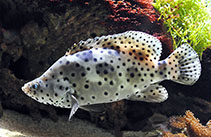
soft rays: 9 - 10. This species is easily distinguished by its extreme smallness of size of the anterior part of the head as compared to the elevated postorbital part; absence of canine teeth, except for a very small pair at the front of the upper jaw; D X, 17-19; A III, 10 (rarely 9); a slit-like posterior nostril; color greenish white to light greenish brown with scattered round black spots on head, body, and fins, with body spots generally larger than those on head and fins; about 9 large roundish dusky blotches may be present on body, with some extending partly into base of dorsal and anal fins (Ref. 5222); characterized further by having moderately deep body, greatest depth 2.5-3.0 in SL; small eyes; concave dorsal profile of head; rounded caudal fin (Ref. 90102).
Generally inhabit lagoon and seaward reefs and are typically found in dead or silty areas (Ref. 9710). Also found around coral reefs and in tide pools. Growth is very slow. Feed on small fishes and crustaceans (Ref. 37816). Artificial spawning was accomplished in the work of Tang et al. 1979 (Ref. 6568) where buoyant eggs measured 0.80-0.83 mm in diameter with a single oil droplet. Larvae died 7 days after hatching. Juveniles are commonly caught for the aquarium trade while adults are utilized as food fish (Ref. 9710). Sold in Hong Kong live fish markets (Ref. 27253).
Life cycle and mating behavior
Maturity | Reproduction | Spawning | Eggs | Fecundity | Larvae
Heemstra, P.C. and J.E. Randall, 1993. FAO Species Catalogue. Vol. 16. Groupers of the world (family Serranidae, subfamily Epinephelinae). An annotated and illustrated catalogue of the grouper, rockcod, hind, coral grouper and lyretail species known to date. Rome: FAO. FAO Fish. Synop. 125(16):382 p. (Ref. 5222)
IUCN Red List Status (Ref. 130435)
Threat to humans
Harmless
Human uses
Fisheries: commercial; aquaculture: commercial; aquarium: commercial
Tools
Special reports
Download XML
Internet sources
Estimates based on models
Preferred temperature (Ref.
123201): 25 - 29, mean 28 °C (based on 702 cells).
Phylogenetic diversity index (Ref.
82804): PD
50 = 1.0000 [Uniqueness, from 0.5 = low to 2.0 = high].
Bayesian length-weight: a=0.01349 (0.00676 - 0.02691), b=3.12 (2.94 - 3.30), in cm total length, based on LWR estimates for this species & (Sub)family-body (Ref.
93245).
Trophic level (Ref.
69278): 4.5 ±0.80 se; based on food items.
Generation time: 3.7 ( na - na) years. Estimated as median ln(3)/K based on 2
growth studies.
Resilience (Ref.
120179): Medium, minimum population doubling time 1.4 - 4.4 years (Preliminary K or Fecundity.).
Fishing Vulnerability (Ref.
59153): Low to moderate vulnerability (34 of 100).
Nutrients (Ref.
124155): Calcium = 29.8 [16.1, 56.4] mg/100g; Iron = 0.524 [0.280, 0.985] mg/100g; Protein = 18.5 [16.5, 20.3] %; Omega3 = 0.113 [0.066, 0.190] g/100g; Selenium = 36.5 [18.6, 74.0] μg/100g; VitaminA = 66 [18, 285] μg/100g; Zinc = 0.633 [0.403, 0.990] mg/100g (wet weight);