Elasmobranchii (sharks and rays) >
Carcharhiniformes (Ground sharks) >
Pentanchidae (Deepwater catsharks)
Etymology: Figaro: Presumably named for the eponymous barber in various dramas (e.g., The Marriage of Figaro), allusion not explained nor evident (See ETYFish); striatus: Latin for grooved or furrowed (authors say “striped,” referring to its striped color pattern (See ETYFish).
Eponymy: Figaro is the eponymous: Barber of Seville (opera by Rossini) and of Mozart’s: The Marriage of Figaro. [...] (Ref. 128868), visit book page.
More on authors: Gledhill, Last & White.
Environment: milieu / climate zone / depth range / distribution range
Ecology
Marine; bathydemersal; depth range 300 - 419 m (Ref. 76950). Tropical
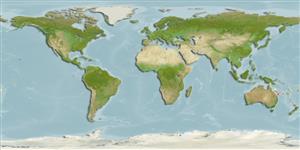
Western Pacific: Australia.
Size / Weight / Age
Maturity: Lm ? range ? - 38 cm
Max length : 42.1 cm TL male/unsexed; (Ref. 76950); 36.9 cm TL (female)
Short description
Identification keys | Morphology | Morphometrics
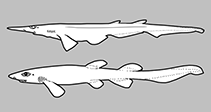
A very small species of catshark with the following characters: head in dorsoventral view narrowly parabolic, short 17.2-19.6% TL; small eye, its length 3.4-3.9% TL, 1.73-2.03 in snout, dorsolaterally located; well developed labial furrows , extending well beyond corners of mouth, lower furrow is slightly longer than the upper one; first dorsal fin is slightly smaller than the second one; small pelvic fins, slender, length 8.8-11.3% TL; posterior portion strongly directed posterodorsally (forming a small lobe, enveloping partly the proximo-lateral margin of clasper); strongly convex inner margin, forming a partial apron and connected to clasper dorsomedially near its base, soft tissue connecting insertions of pelvic fins is weak, not forming a prominent apron overlying ventral surface of tail; a much longer anal-fin base than second dorsal fin, base 9.9-10.9% TL, 2.4-6.0 times anal-caudal space; long caudal peduncle, anal-caudal space 1.6-4.2% TL; crest of enlarged denticles on anterior dorsal caudal-fin margin extending from about over origin of ventral caudal-fin lobe to almost mid-length of dorsal caudal-fin margin; crest of enlarged denticles originating at mid-point of caudal peduncle, extending to elevated part of ventral lobe; size at maturity for at about 38.0 cm TL; preserved color pale brown dorsally, with dark saddles and bars, lighter ventrally; pre-dorsally with about 4 larger saddles; saddles present below and between dorsal fins and extending onto caudal, these are rarely larger than eye diameter; larger saddles are pale edged, separated by narrower, less distinct bars; saddles rarely extending below the lateral midline; 35-38 monospondylous vertebrae; 85-93 precaudal; 140-149 in total (Ref. 76950).
Body shape (shape guide): elongated.
Life cycle and mating behavior
Maturity | Reproduction | Spawning | Eggs | Fecundity | Larvae
Gledhill, D.C., P.R. Last and W.T. White, 2008. Resurrection of the genus Figaro Whitley (Carcharhiniformes: Scyliorhinidae) with the description of a new species from northeastern Australia. In Last, P.R., White, W.T. & Pogonoski, J.J. (eds.): Descriptions of New Australian Chondrichthyans. CSIRO Marine and Atmospheric Research Paper no. 22. (Ref. 76950)
IUCN Red List Status (Ref. 130435: Version 2025-1)
Threat to humans
Harmless
Human uses
Tools
Special reports
Download XML
Internet sources
Estimates based on models
Preferred temperature (Ref.
123201): 7.1 - 17.4, mean 13 °C (based on 20 cells).
Phylogenetic diversity index (Ref.
82804): PD
50 = 0.7500 [Uniqueness, from 0.5 = low to 2.0 = high].
Bayesian length-weight: a=0.00355 (0.00175 - 0.00721), b=3.08 (2.90 - 3.26), in cm total length, based on LWR estimates for this (Sub)family-body shape (Ref.
93245).
Trophic level (Ref.
69278): 4.0 ±0.5 se; based on size and trophs of closest relatives
Resilience (Ref.
120179): Low, minimum population doubling time 4.5 - 14 years (Preliminary low fecundity).
Fishing Vulnerability (Ref.
59153): Low to moderate vulnerability (32 of 100).
🛈