Teleostei (teleosts) >
Tetraodontiformes (Puffers and filefishes) >
Diodontidae (Porcupinefishes (burrfishes))
Etymology: Chilomycterus: Greek, cheilos = lip + Greek, mykter, -eros = nose (Ref. 45335).
More on author: Walbaum.
Environment: milieu / climate zone / depth range / distribution range
Ecology
Marine; reef-associated; depth range 1 - 11 m (Ref. 9710). Tropical; 46°N - 5°S, 98°W - 34°W
Western Atlantic: Nova Scotia (Canada), Maine (USA), Bahamas, and northern Gulf of Mexico to Brazil. Uncommon or absent from most of West Indies.
Size / Weight / Age
Maturity: Lm ? range ? - ? cm
Max length : 27.9 cm TL male/unsexed; (Ref. 40637); max. published weight: 630.00 g (Ref. 4699)
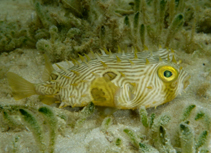
No spines wholly on caudal peduncle. Supraocular tentacles absent or much smaller than eyes. 5 to 7 large dark blotches on back and sides, with many, approximately parallel to obliquely intersecting dark lines distributed over light background colour. No small, dark spots either on body or fin (Ref 53034).
Very common in seagrass beds in bays and coastal lagoons. Also found on shallow coastal reefs (Ref. 9710). Has been traded as an aquarium fish at Ceará, Brazil (Ref. 49392).
Life cycle and mating behavior
Maturity | Reproduction | Spawning | Eggs | Fecundity | Larvae
Robins, C.R. and G.C. Ray, 1986. A field guide to Atlantic coast fishes of North America. Houghton Mifflin Company, Boston, U.S.A. 354 p. (Ref. 7251)
IUCN Red List Status (Ref. 130435)
Threat to humans
Harmless
Human uses
Fisheries: of no interest; gamefish: yes; aquarium: commercial
More information
Common namesSynonymsMetabolismPredatorsEcotoxicologyReproductionMaturitySpawningSpawning aggregationFecundityEggsEgg development
ReferencesAquacultureAquaculture profileStrainsGeneticsElectrophoresesHeritabilityDiseasesProcessingNutrientsMass conversion
Tools
Special reports
Download XML
Internet sources
Estimates based on models
Preferred temperature (Ref.
123201): 18.4 - 28, mean 26.9 °C (based on 501 cells).
Phylogenetic diversity index (Ref.
82804): PD
50 = 0.5313 [Uniqueness, from 0.5 = low to 2.0 = high].
Bayesian length-weight: a=0.04786 (0.01967 - 0.11644), b=2.82 (2.61 - 3.03), in cm total length, based on LWR estimates for this (Sub)family-body shape (Ref.
93245).
Trophic level (Ref.
69278): 3.5 ±0.37 se; based on food items.
Resilience (Ref.
120179): High, minimum population doubling time less than 15 months (Preliminary K or Fecundity.).
Fishing Vulnerability (Ref.
59153): Low vulnerability (18 of 100).
Nutrients (Ref.
124155): Calcium = 52 [22, 127] mg/100g; Iron = 0.646 [0.310, 1.460] mg/100g; Protein = 18.4 [16.2, 20.5] %; Omega3 = 0.1 [0.1, 0.2] g/100g; Selenium = 26.3 [13.2, 55.5] μg/100g; VitaminA = 58.8 [17.0, 209.9] μg/100g; Zinc = 1.19 [0.79, 1.80] mg/100g (wet weight);