Teleostei (teleosts) >
Eupercaria/misc (Various families in series Eupercaria) >
Scaridae (Parrotfishes) > Scarinae
Etymology: Scarus: Greek, skaros = a fish described by anciente writers as a parrot fish; 1601 (Ref. 45335).
More on author: Valenciennes.
Environment: milieu / climate zone / depth range / distribution range
Ecology
Marine; reef-associated; depth range 1 - 30 m (Ref. 40827). Tropical
Southwest Atlantic: endemic to Brazil.
Size / Weight / Age
Maturity: Lm ? range ? - ? cm
Max length : 55.6 cm SL male/unsexed; (Ref. 114982)
Short description
Morphology | Morphometrics
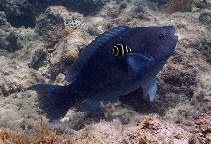
This species lacks a large pale area on the head (extending from the throat to snout) that is present in S. coelestinus. S. trispinosus has roughly homogenously-colored scales on flanks unlike in S. coelestinus where flank scales have distinct dark margins. S. trispinosus also lack the irregular bright-blue blotches on nape and around the eye. Juveniles are similarly colored as the adults, but bear a yellowish area on nape, similar to subadults of S. coelestinus (Ref. 40827).
Occurs in coral, algal and rocky reefs and on algal beds (Ref. 40827).
Life cycle and mating behavior
Maturity | Reproduction | Spawning | Eggs | Fecundity | Larvae
Oviparous, distinct pairing during breeding (Ref. 205).
Moura, R.L., J.L. de Figueiredo and I. Sazima, 2001. A new parrotfish (Scaridae) from Brazil, and revalidation of Sparisoma amplum (Ranzani, 1842), Sparisoma frondosum (Agassiz, 1831), Sparisoma axillare (Steindachner, 1878) and Scarus trispinosus Valenciennes, 1840. Bull. Mar. Sci. 68(3):505-524. (Ref. 40827)
IUCN Red List Status (Ref. 130435)
Threat to humans
Harmless
Human uses
More information
ReferencesAquacultureAquaculture profileStrainsGeneticsElectrophoresesHeritabilityDiseasesProcessingNutrientsMass conversion
Tools
Special reports
Download XML
Internet sources
Estimates based on models
Preferred temperature (Ref.
123201): 23.5 - 27.6, mean 27.1 °C (based on 162 cells).
Phylogenetic diversity index (Ref.
82804): PD
50 = 0.5000 [Uniqueness, from 0.5 = low to 2.0 = high].
Bayesian length-weight: a=0.01862 (0.01050 - 0.03303), b=3.05 (2.90 - 3.20), in cm total length, based on LWR estimates for this species & Genus-body shape (Ref.
93245).
Resilience (Ref.
120179): Medium, minimum population doubling time 1.4 - 4.4 years (Preliminary K or Fecundity.).
Fishing Vulnerability (Ref.
59153): Moderate to high vulnerability (47 of 100).
Nutrients (Ref.
124155): Calcium = 30.6 [19.9, 51.0] mg/100g; Iron = 0.67 [0.47, 1.02] mg/100g; Protein = 18.6 [16.5, 20.4] %; Omega3 = 0.0835 [, ] g/100g; Selenium = 19.8 [12.4, 31.6] μg/100g; VitaminA = 46.2 [13.9, 150.1] μg/100g; Zinc = 2.04 [1.54, 2.63] mg/100g (wet weight);