Environment: milieu / climate zone / depth range / distribution range
Ecology
Marine; freshwater; brackish; pelagic-neritic; depth range 0 - 50 m (Ref. 189). Tropical; 21°N - 26°S, 76°E - 153°E (Ref. 189)
Indo-Pacific: Indian Ocean (Sri Lanka and India) and western Pacific (Java, Sulawesi, Timor, Ambon, the Philippines and northern Queensland). Presumably more widespread in the Indian Ocean, but not previously separated from Thryssa baelama.
Size / Weight / Age
Maturity: Lm ? range ? - ? cm
Max length : 10.7 cm SL male/unsexed; (Ref. 189)
Dorsal
spines
(total): 0;
Anal
spines: 0;
Anal
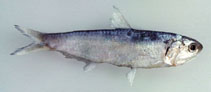
soft rays: 24 - 28. Almost identical to T. baelama except in the following: 1 or 2 keeled scutes without arms immediately behind the isthmus, first and second supra-maxilla relatively longer, tip of maxilla blunter and perhaps not always reaching to front border of pre-operculum; also, fewer branched anal fin rays and fewer ;re-caudal but more caudal vertebrae (Ref. 189).
Its habitat and biology is probably similar to T. baelama, but not separated from it in previous records.
Life cycle and mating behavior
Maturity | Reproduction | Spawning | Eggs | Fecundity | Larvae
Wongratana, T., T.A. Munroe and M. Nizinski, 1999. Order Clupeiformes. Engraulidae. Anchovies. p. 1698-1753. In K.E. Carpenter and V.H. Niem (eds.) FAO species identification guide for fishery purposes. The living marine resources of the WCP. Vol. 3. Batoid fishes, chimaeras and bony fishes part 1 (Elopidae to Linophrynidae). FAO, Rome. (Ref. 9822)
IUCN Red List Status (Ref. 130435)
Threat to humans
Harmless
Human uses
Fisheries: minor commercial
More information
Common namesSynonymsMetabolismPredatorsEcotoxicologyReproductionMaturitySpawningSpawning aggregationFecundityEggsEgg development
ReferencesAquacultureAquaculture profileStrainsGeneticsElectrophoresesHeritabilityDiseasesProcessingNutrientsMass conversion
Tools
Special reports
Download XML
Internet sources
Estimates based on models
Preferred temperature (Ref.
123201): 27.3 - 29, mean 28.4 °C (based on 538 cells).
Phylogenetic diversity index (Ref.
82804): PD
50 = 0.5000 [Uniqueness, from 0.5 = low to 2.0 = high].
Bayesian length-weight: a=0.00437 (0.00186 - 0.01024), b=3.11 (2.93 - 3.29), in cm total length, based on LWR estimates for this Genus-body shape (Ref.
93245).
Trophic level (Ref.
69278): 3.3 ±0.5 se; based on size and trophs of closest relatives
Resilience (Ref.
120179): High, minimum population doubling time less than 15 months (Preliminary K or Fecundity.).
Fishing Vulnerability (Ref.
59153): Low vulnerability (10 of 100).