Teleostei (teleosts) >
Clupeiformes (Herrings) >
Engraulidae (Anchovies) > Engraulinae
Etymology: Stolephorus: Greek, stole, -es = garment + Greek, pherein = to carry (Ref. 45335).
Environment: milieu / climate zone / depth range / distribution range
Ecology
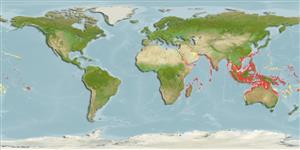
Marine; brackish; pelagic-neritic; oceanodromous; depth range 20 - 50 m (Ref. 28016). Tropical; 30°N - 37°S, 23°E - 144°W (Ref. 189)
Indian Ocean: from the Red Sea to Ranong and Phuket, Thailand.
Length at first maturity / Size / Weight / Age
Maturity: Lm 9.0, range 12 - ? cm
Max length : 15.5 cm SL male/unsexed; (Ref. 30573); common length : 12.0 cm SL male/unsexed; (Ref. 30573)
Dorsal
spines
(total): 0;
Dorsal
soft rays
(total): 15-17;
Anal
spines: 0;
Anal
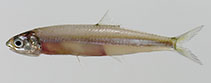
soft rays: 19 - 21. Diagnosis: Body slender, elongate, rather round in cross-section, belly rounded, with 2-6 small needle-like pre-pelvic scutes; maxilla tip pointed, reaching to or only just beyond front border of pre-operculum; hind border of pre-operculum convex, rounded; lower gillrakers 20-28; isthmus muscle tapering evenly forward to hind border of branchial membrane; pelvic fin tips not reaching to below dorsal fin origin; anal fin short, with usually 3 unbranched and 16-18 branched finrays, its origin below centre of dorsal fin base; body light transparent fleshy brown, with a silver stripe down flank; no dark pigment lines on back between head and dorsal fin (Ref. 189). Other species with such a short maxilla are Stolephorus advenus, with 7 pre-pelvic scutes, and S. pacificus, with 35-38 gillrakers; maxilla to or almost to hind border of pre-operculum in other Stolephorus species (Ref. 189).
A schooling species occurring in coastal waters and which appears to enter at least the estuarine parts of rivers and to tolerate brackish water. Coastal pelagic (Ref. 68964). Feeds most likely on zooplankton, but more data needed. Used as bait in the tuna fishery in the South Pacific, although said to be fragile. Also Ref. 58652.
In Manila Bay, migrates out into deeper and more saline water to breed (at about 9 cm SL and above), returning immediately thereafter.
Hata, H., S. Lavoué and H. Motomura, 2021. Taxonomic status of nominal species of the anchovy genus Stolephorus previously regarded as synonyms of Stolephorus commersonnii Lacepède 1803 and Stolephorus indicus (van Hasselt 1823), and descriptions of three new species (Clupeiformes: Engraulidae). Ichthyol. Res. 68(3):327-372. (Ref. 123745)
IUCN Red List Status (Ref. 130435)
Threat to humans
Harmless
Human uses
Fisheries: minor commercial; bait: occasionally
More information
ReferencesAquacultureAquaculture profileStrainsGeneticsElectrophoresesHeritabilityDiseasesProcessingNutrientsMass conversion
Tools
Special reports
Download XML
Internet sources
Estimates based on models
Preferred temperature (Ref.
123201): 24.2 - 28.7, mean 27.9 °C (based on 362 cells).
Phylogenetic diversity index (Ref.
82804): PD
50 = 0.5000 [Uniqueness, from 0.5 = low to 2.0 = high].
Bayesian length-weight: a=0.00537 (0.00454 - 0.00635), b=3.14 (3.09 - 3.19), in cm total length, based on LWR estimates for this species (Ref.
93245).
Trophic level (Ref.
69278): 3.6 ±0.0 se; based on diet studies.
Resilience (Ref.
120179): High, minimum population doubling time less than 15 months (K=0.71-1.42).
Fishing Vulnerability (Ref.
59153): Low vulnerability (13 of 100).
Nutrients (Ref.
124155): Calcium = 388 [142, 1,010] mg/100g; Iron = 2.22 [1.20, 3.83] mg/100g; Protein = 18.9 [17.1, 20.8] %; Omega3 = 0.28 [0.12, 0.64] g/100g; Selenium = 59.4 [25.1, 135.9] μg/100g; VitaminA = 25.6 [6.0, 101.2] μg/100g; Zinc = 2.38 [1.55, 3.73] mg/100g (wet weight); based on
nutrient studies.