Elasmobranchii (sharks and rays) >
Myliobatiformes (Stingrays) >
Urotrygonidae (American round stingrays)
Etymology: Urotrygon: Greek, oura = tail + Greek, trygon = a sting ray (Ref. 45335).
More on author: Schultz.
Environment: milieu / climate zone / depth range / distribution range
Ecology
Marine; demersal. Tropical
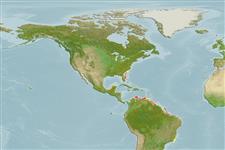
Western Central Atlantic: Gulf of Venezuela.
Length at first maturity / Size / Weight / Age
Maturity: Lm 17.6 range ? - ? cm
Max length : 29.5 cm TL male/unsexed; (Ref. 127655); 36.2 cm TL (female)
Short description
Morphology | Morphometrics
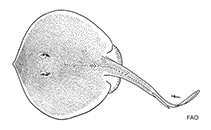
Prickly back with a median row of slightly larger spines from the nuchal region rearward along disc and anterior part of tail. Wide disc and tail long. Plain greyish above, without markings, cream colored below (Ref. 6902).
Life cycle and mating behavior
Maturity | Reproduction | Spawning | Eggs | Fecundity | Larvae
Compagno, L.J.V., 1999. Checklist of living elasmobranchs. p. 471-498. In W.C. Hamlett (ed.) Sharks, skates, and rays: the biology of elasmobranch fishes. Johns Hopkins University Press, Maryland. (Ref. 35766)
IUCN Red List Status (Ref. 130435)
Threat to humans
Harmless
Human uses
More information
Age/SizeGrowthLength-weightLength-lengthLength-frequenciesMorphometricsMorphologyLarvaeLarval dynamicsRecruitmentAbundanceBRUVS
ReferencesAquacultureAquaculture profileStrainsGeneticsElectrophoresesHeritabilityDiseasesProcessingNutrientsMass conversion
Tools
Special reports
Download XML
Internet sources
Estimates based on models
Preferred temperature (Ref.
123201): 25.4 - 28.4, mean 27 °C (based on 54 cells).
Phylogenetic diversity index (Ref.
82804): PD
50 = 0.5001 [Uniqueness, from 0.5 = low to 2.0 = high].
Bayesian length-weight: a=0.01413 (0.00575 - 0.03468), b=3.07 (2.86 - 3.28), in cm total length, based on LWR estimates for this (Sub)family-body shape (Ref.
93245).
Trophic level (Ref.
69278): 3.7 ±0.6 se; based on size and trophs of closest relatives
Resilience (Ref.
120179): Low, minimum population doubling time 4.5 - 14 years (Assuming fecundity<100).
Fishing Vulnerability (Ref.
59153): Low to moderate vulnerability (26 of 100).