Classification / Names
Common names | Synonyms | Catalog of Fishes(genus, species) | ITIS | CoL | WoRMS | Cloffa
Teleostei (teleosts) >
Characiformes (Characins) >
Characidae (Characins; tetras) > Stevardiinae
Etymology: Hemibrycon: Greek, hemi = half + Greek, bryko = to bite (Ref. 45335).
Environment: milieu / climate zone / depth range / distribution range
Ecology
Freshwater; benthopelagic. Tropical
South America: Bolivia.
Size / Weight / Age
Maturity: Lm ? range ? - ? cm
Max length : 8.1 cm SL male/unsexed; (Ref. 85819); 3.4 cm SL (female)
Short description
Morphology | Morphometrics
Dorsal
soft rays
(total): 7-8;
Anal
soft rays: 15 - 19;
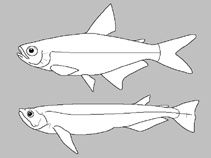
Vertebrae: 39. This species is distinguished from most congeners, except H. mikrostiktos, H. paez, H. tridens, and H. virolinica, by the number of branched anal-fin rays 15-19 (vs. 20-34); Hemibrycon beni differs from these species by the number of lateral line scales 44-53 (vs. 40-42, 39-42, 39, and 40-44, respectively). H. beni differs from H. virolinica by the number of predorsal scales 17-20 (vs. 10-15). H. beni when compared with H. helleri, overlap somewhat with branched anal-fin ray counts 15-19 (vs. 19-23 for the latter), but can be distinguished from each other by the size of humeral spot 3-4 horizontal series of scales and the total number of vertebrae 38-39 in H. beni (vs. 7-8 in horizontal series of scales and 41-43 vertebrae, respectively for H. helleri) (Ref. 85819).
Life cycle and mating behavior
Maturity | Reproduction | Spawning | Eggs | Fecundity | Larvae
Bertaco, V.A. and L.R. Malabarba, 2010. A review of the Cis-Andean species of Hemibrycon Günther (Teleostei: Characiformes: Characidae: Stevardiinae), with description of two new species. Neotrop. Ichthyol. 8(4):737-770. (Ref. 85819)
IUCN Red List Status (Ref. 130435)
Threat to humans
Harmless
Human uses
More information
Common namesSynonymsMetabolismPredatorsEcotoxicologyReproductionMaturitySpawningSpawning aggregationFecundityEggsEgg development
Age/SizeGrowthLength-weightLength-lengthLength-frequenciesMorphometricsMorphologyLarvaeLarval dynamicsRecruitmentAbundanceBRUVS
ReferencesAquacultureAquaculture profileStrainsGeneticsElectrophoresesHeritabilityDiseasesProcessingNutrientsMass conversion
Tools
Special reports
Download XML
Internet sources
Estimates based on models
Phylogenetic diversity index (Ref.
82804): PD
50 = 0.5000 [Uniqueness, from 0.5 = low to 2.0 = high].
Bayesian length-weight: a=0.00813 (0.00372 - 0.01775), b=3.09 (2.90 - 3.28), in cm total length, based on LWR estimates for this (Sub)family-body shape (Ref.
93245).
Trophic level (Ref.
69278): 3.0 ±0.4 se; based on size and trophs of closest relatives
Resilience (Ref.
120179): High, minimum population doubling time less than 15 months (Preliminary K or Fecundity.).
Fishing Vulnerability (Ref.
59153): Low vulnerability (10 of 100).