Teleostei (teleosts) >
Stomiiformes (Lightfishes and dragonfishes) >
Stomiidae (Barbeled dragonfishes) > Astronesthinae
Etymology: Astronesthes: Greek, astra = ray + Greek, esthes, -es = suit, something used to wrap (Ref. 45335); atlanticus: The specific name is related to the species range, which lies within limits of the Atlantic Ocean (Ref. 27676).
Environment: milieu / climate zone / depth range / distribution range
Ecology
Marine; bathypelagic; depth range 300 - 1200 m (Ref. 27676). Deep-water
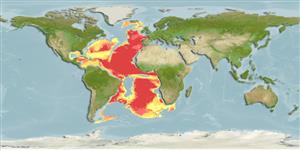
Atlantic Ocean: Endemic to warm waters of the Atlantic Ocean.
Size / Weight / Age
Maturity: Lm ? range ? - ? cm
Max length : 16.3 cm SL male/unsexed; (Ref. 27676)
Short description
Morphology | Morphometrics
Dorsal
soft rays
(total): 14-15;
Anal
soft rays: 13 - 15;
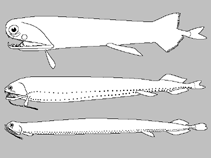
Vertebrae: 43 - 45. Last photophore of VAL series behind origin of anal and last photophore of VAV series. Aggregation of luminous tissue on head, when fully developed in fish > 7 cm SL, forming two triangular spots in upper and lower corners of gill cover; longitudinally orientated aggregations of luminous tissue on the anterior part of body, the largest of them behind pectoral fin insertion (slightly above lateral row of photophores) and close to pelvic fins (above median line of body and immediately above lateral row of photophores) (Ref. 27676).
Life cycle and mating behavior
Maturity | Reproduction | Spawning | Eggs | Fecundity | Larvae
Parin, N.V. and O.D. Borodulina, 1996. Revision of the Astronesthes indicus species group (Astronesthidae), with descriptions of five new species. J. Ichthyol. 36(8):551-565. (Ref. 27676)
IUCN Red List Status (Ref. 130435)
Threat to humans
Harmless
Human uses
More information
Common namesSynonymsMetabolismPredatorsEcotoxicologyReproductionMaturitySpawningSpawning aggregationFecundityEggsEgg development
Age/SizeGrowthLength-weightLength-lengthLength-frequenciesMorphometricsMorphologyLarvaeLarval dynamicsRecruitmentAbundanceBRUVS
ReferencesAquacultureAquaculture profileStrainsGeneticsElectrophoresesHeritabilityDiseasesProcessingNutrientsMass conversion
Tools
Special reports
Download XML
Internet sources
Estimates based on models
Preferred temperature (Ref.
123201): 3.1 - 5.2, mean 4.6 °C (based on 70 cells).
Phylogenetic diversity index (Ref.
82804): PD
50 = 0.5000 [Uniqueness, from 0.5 = low to 2.0 = high].
Bayesian length-weight: a=0.00417 (0.00171 - 0.01014), b=3.05 (2.83 - 3.27), in cm total length, based on LWR estimates for this (Sub)family-body shape (Ref.
93245).
Trophic level (Ref.
69278): 3.9 ±0.6 se; based on size and trophs of closest relatives
Resilience (Ref.
120179): Medium, minimum population doubling time 1.4 - 4.4 years (Assuming tmax>3).
Fishing Vulnerability (Ref.
59153): Low vulnerability (10 of 100).