Teleostei (teleosts) >
Acanthuriformes (Surgeonfishes) >
Acanthuridae (Surgeonfishes, tangs, unicornfishes) > Acanthurinae
Etymology: Acanthurus: Greek, akantha = thorn + Greek, oura = tail (Ref. 45335).
Environment: milieu / climate zone / depth range / distribution range
Ecology
Marine; reef-associated; depth range 0 - 60 m (Ref. 1602), usually 5 - 40 m (Ref. 27115). Tropical; 32°N - 24°S, 55°E - 138°W
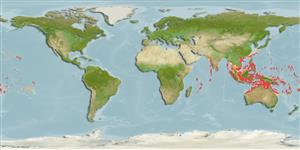
Indo-Pacific: Seychelles to the Marquesas and Tuamoto islands, north to southern Japan, south to the Great Barrier Reef and New Caledonia. Replaced by Acanthurus trisits from the Maldives and Chagos Islands to Bali (Ref. 37816).
Size / Weight / Age
Maturity: Lm ? range ? - ? cm
Max length : 29.0 cm TL male/unsexed; (Ref. 90102)
Dorsal
spines
(total): 8;
Dorsal
soft rays
(total): 27-30;
Anal
spines: 3;
Anal
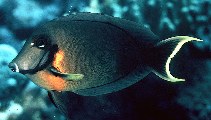
soft rays: 24 - 28. Purplish black in color; an orange diffused patch at edge of gill opening, just above pectoral fin base; a broad black band from upper end of gill opening to margin of gill cover down to isthmus; caudal spine socket with a narrow black margin. Blackish lips; a trace of orange behind eye; a white line under chin extending slightly above rictus. Gill rakers on anterior row 23-26; on posterior row 25-27. Juveniles can exhibit 3 different color patterns mimicking Centropyge species. Caudal fin rounded in juveniles.
Occurs in lagoon and seaward reefs; prefers areas of mixed coral, rock, or sand at the base of reefs or ledges, Ref. 48637. Also on silty reefs (Ref. 9710). Found singly (Ref. 9710). Juveniles mimic Centropyge spp. (in Guam, juveniles mimic C. flavissimus but in Palau where this species is absent, they mimic C. vrolikii), Ref. 48637. Presence of a venom gland could not be determined despite the presence of distinct anterolateral grooves; this may be due to the loss of venom glands in adults (Ref. 57406). Feeds on algae (Ref. 89972). Minimum depth reported taken from Ref. 128797.
Life cycle and mating behavior
Maturity | Reproduction | Spawning | Eggs | Fecundity | Larvae
Randall, J.E., 1956. A revision of the surgeonfish genus Acanthurus. Pac. Sci. 10(2):159-235. (Ref. 1920)
IUCN Red List Status (Ref. 130435)
Threat to humans
Harmless
Human uses
Fisheries: commercial; aquarium: commercial
More information
Common namesSynonymsMetabolismPredatorsEcotoxicologyReproductionMaturitySpawningSpawning aggregationFecundityEggsEgg development
ReferencesAquacultureAquaculture profileStrainsGeneticsElectrophoresesHeritabilityDiseasesProcessingNutrientsMass conversion
Tools
Special reports
Download XML
Internet sources
Estimates based on models
Preferred temperature (Ref.
123201): 25 - 28.8, mean 27.6 °C (based on 558 cells).
Phylogenetic diversity index (Ref.
82804): PD
50 = 0.5000 [Uniqueness, from 0.5 = low to 2.0 = high].
Bayesian length-weight: a=0.02344 (0.01103 - 0.04981), b=2.96 (2.79 - 3.13), in cm total length, based on LWR estimates for this Genus-body shape (Ref.
93245).
Trophic level (Ref.
69278): 2.0 ±0.00 se; based on food items.
Generation time: 2.6 ( na - na) years. Estimated as median ln(3)/K based on 1
growth studies.
Resilience (Ref.
120179): Medium, minimum population doubling time 1.4 - 4.4 years (K=0.422; Tmax=28).
Fishing Vulnerability (Ref.
59153): Low to moderate vulnerability (29 of 100).
Nutrients (Ref.
124155): Calcium = 60.6 [25.4, 172.2] mg/100g; Iron = 0.749 [0.287, 1.819] mg/100g; Protein = 18.1 [16.8, 19.3] %; Omega3 = 0.107 [0.049, 0.224] g/100g; Selenium = 19.1 [6.7, 57.1] μg/100g; VitaminA = 44.1 [10.1, 179.4] μg/100g; Zinc = 2.89 [0.91, 5.30] mg/100g (wet weight);