Teleostei (teleosts) >
Ovalentaria/misc (Various families in series Ovalentaria) >
Pomacentridae (Damselfishes) > Pomacentrinae
Etymology: Amphiprion: Greek, amphi = on both sides + Greek, prion, -onos = saw (Ref. 45335).
More on authors: Schultz & Welander.
Environment: milieu / climate zone / depth range / distribution range
Ecology
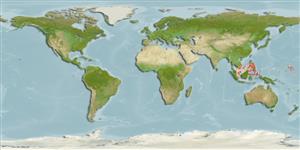
Marine; reef-associated; non-migratory; depth range 3 - 40 m (Ref. 7247). Tropical; 25°C - ?; 15°N - 0°N
Western Pacific: Marshall Islands. Reported from New Caledonia (Ref. 9070).
Length at first maturity / Size / Weight / Age
Maturity: Lm 7.5, range 7 - 8 cm
Max length : 12.0 cm TL male/unsexed; (Ref. 9710)
Dorsal
spines
(total): 10 - 11;
Dorsal
soft rays
(total): 15-17;
Anal
spines: 2;
Anal
soft rays: 13 - 14. Black or orange with two vertical black-edged white bands, one behind the eye and one above the after. Black and orange color morphs believed to be dependent on which species of sea anemone the fish is associated with.
Life cycle and mating behavior
Maturity | Reproduction | Spawning | Eggs | Fecundity | Larvae
Oviparous, distinct pairing during breeding (Ref. 205). Eggs are demersal and adhere to the substrate (Ref. 205). Males guard and aerate the eggs (Ref. 205). Also Ref. 7471.
Allen, G.R., 1991. Damselfishes of the world. Mergus Publishers, Melle, Germany. 271 p. (Ref. 7247)
IUCN Red List Status (Ref. 130435)
Threat to humans
Harmless
Human uses
Fisheries: of no interest; aquarium: commercial
More information
ReferencesAquacultureAquaculture profileStrainsGeneticsElectrophoresesHeritabilityDiseasesProcessingNutrientsMass conversion
Tools
Special reports
Download XML
Internet sources
Estimates based on models
Preferred temperature (Ref.
123201): 27.7 - 29.1, mean 28.5 °C (based on 28 cells).
Phylogenetic diversity index (Ref.
82804): PD
50 = 0.5000 [Uniqueness, from 0.5 = low to 2.0 = high].
Bayesian length-weight: a=0.02512 (0.01571 - 0.04016), b=2.96 (2.82 - 3.10), in cm total length, based on LWR estimates for this species & (Sub)family-body (Ref.
93245).
Trophic level (Ref.
69278): 2.3 ±0.0 se; based on diet studies.
Generation time: 3.1 ( na - na) years. Estimated as median ln(3)/K based on 1
growth studies.
Resilience (Ref.
120179): Medium, minimum population doubling time 1.4 - 4.4 years (K=0.3).
Fishing Vulnerability (Ref.
59153): Low to moderate vulnerability (31 of 100).