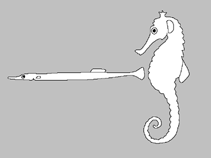
Teleostei (teleosts) >
Syngnathiformes (Pipefishes and seahorses) >
Syngnathidae (Pipefishes and seahorses) > Syngnathinae
Etymology: Syngnathus: Greek, syn, symphysis = grown together + Greek, gnathos = jaw (Ref. 45335).
More on author: Gilbert.
Environment: milieu / climate zone / depth range / distribution range
Ecology
Marine; demersal. Subtropical
Eastern Central Pacific: endemic to the northern Gulf of California.
Length at first maturity / Size / Weight / Age
Maturity: Lm ?, range 18 - ? cm
Max length : 23.0 cm SL male/unsexed; (Ref. 5316)
Ovoviviparous (Ref. 205). The male carries the eggs in a brood pouch which is found under the tail (Ref. 205). Males may be mature at 17.5 cm SL.
Life cycle and mating behavior
Maturity | Reproduction | Spawning | Eggs | Fecundity | Larvae
Male carries the eggs in a brood pouch (Ref. 205).
Dawson, C.E., 1985. Indo-Pacific pipefishes (Red Sea to the Americas). The Gulf Coast Research Laboratory Ocean Springs, Mississippi, USA. (Ref. 5316)
IUCN Red List Status (Ref. 130435)
Threat to humans
Harmless
Human uses
More information
Age/SizeGrowthLength-weightLength-lengthLength-frequenciesMorphometricsMorphologyLarvaeLarval dynamicsRecruitmentAbundanceBRUVS
ReferencesAquacultureAquaculture profileStrainsGeneticsElectrophoresesHeritabilityDiseasesProcessingNutrientsMass conversion
Tools
Special reports
Download XML
Internet sources
Estimates based on models
Phylogenetic diversity index (Ref.
82804): PD
50 = 0.5000 [Uniqueness, from 0.5 = low to 2.0 = high].
Bayesian length-weight: a=0.00028 (0.00012 - 0.00065), b=3.21 (3.03 - 3.39), in cm total length, based on LWR estimates for this Genus-body shape (Ref.
93245).
Trophic level (Ref.
69278): 3.3 ±0.5 se; based on size and trophs of closest relatives
Resilience (Ref.
120179): High, minimum population doubling time less than 15 months (Preliminary K or Fecundity.).
Fishing Vulnerability (Ref.
59153): Low vulnerability (18 of 100).