Teleostei (teleosts) >
Kurtiformes (Nurseryfishes, cardinalfishes.) >
Apogonidae (Cardinalfishes) > Apogoninae
Etymology: More on author: Bleeker.
Environment: milieu / climate zone / depth range / distribution range
Ecology
Marine; reef-associated; depth range 1 - 50 m (Ref. 11441), usually 1 - 15 m (Ref. 90102). Tropical; 30°N - 31°S, 30°E - 175°W
Indo-Pacific: Persian Gulf (Ref. 68964) and Red Sea south to Mozambique and east to Fiji, north to the Ryukyu and Bonin islands, south to New Caledonia. Recently recorded from Tonga (Ref. 53797).
Size / Weight / Age
Maturity: Lm ? range ? - ? cm
Max length : 8.0 cm TL male/unsexed; (Ref. 2334); common length : 6.0 cm SL male/unsexed; (Ref. 37816)
Dorsal
spines
(total): 8;
Dorsal
soft rays
(total): 9;
Anal
spines: 2;
Anal
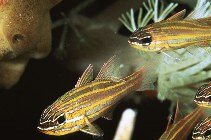
soft rays: 8. Bluish silver in color, with 6 orange-yellow stripes, including a short post ocular stripe. Sub-equal along abdomen, and midlateral stripe ends into pinkish to orange spot on caudal fin base (red at night) (Ref. 48635). Greatest depth of body 2.7-3.0 in SL (Ref. 90102).
Inhabits sheltered clear water areas of lagoon and seaward reefs from depths of 1 to at least 49 m. Found in small or large aggregations under ledges, in holes, or even among long spines of sea urchins. Feeds on planktonic crustaceans and small invertebrates. Has been reared in captivity (Ref. 35404).
Mouthbrooders (Ref. 240). Distinct pairing during courtship and spawning (Ref. 205).
Masuda, H., K. Amaoka, C. Araga, T. Uyeno and T. Yoshino, 1984. The fishes of the Japanese Archipelago. Vol. 1. Tokai University Press, Tokyo, Japan. 437 p. (text). (Ref. 559)
IUCN Red List Status (Ref. 130435)
Threat to humans
Harmless
Human uses
Aquarium: commercial
More information
ReferencesAquacultureAquaculture profileStrainsGeneticsElectrophoresesHeritabilityDiseasesProcessingNutrientsMass conversion
Tools
Special reports
Download XML
Internet sources
Estimates based on models
Preferred temperature (Ref.
123201): 25 - 29.3, mean 28.4 °C (based on 3142 cells).
Phylogenetic diversity index (Ref.
82804): PD
50 = 0.5000 [Uniqueness, from 0.5 = low to 2.0 = high].
Bayesian length-weight: a=0.01349 (0.00840 - 0.02167), b=3.13 (2.99 - 3.27), in cm total length, based on LWR estimates for this species & (Sub)family-body (Ref.
93245).
Trophic level (Ref.
69278): 3.6 ±0.56 se; based on food items.
Resilience (Ref.
120179): High, minimum population doubling time less than 15 months (K=2.93).
Fishing Vulnerability (Ref.
59153): Low vulnerability (10 of 100).
Nutrients (Ref.
124155): Calcium = 221 [107, 630] mg/100g; Iron = 1.71 [0.80, 3.17] mg/100g; Protein = 19 [18, 20] %; Omega3 = 0.172 [0.067, 0.456] g/100g; Selenium = 57.9 [18.9, 160.0] μg/100g; VitaminA = 41.3 [9.2, 177.0] μg/100g; Zinc = 2.95 [1.65, 4.81] mg/100g (wet weight);