Teleostei (teleosts) >
Perciformes/Scorpaenoidei (Scorpionfishes) >
Triglidae (Searobins) > Triglinae
Etymology: Chelidonichthys: Greek, chelidon, -onos = swift, as black as a swift + Greek, ichthys = fish (Ref. 45335).
More on author: Linnaeus.
Environment: milieu / climate zone / depth range / distribution range
Ecology
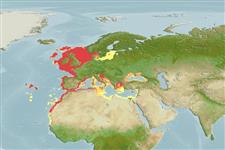
Marine; demersal; depth range 15 - 400 m, usually 30 - 250 m (Ref. 35388). Temperate; 62°N - 15°N, 32°W - 42°E
Eastern Atlantic: British Isles (occasionally Norway) to Mauritania (including Madeira and Azores); throughout the Mediterranean (Ref. 3687); and Black Sea (Ref. 57855, 58342).
Length at first maturity / Size / Weight / Age
Maturity: Lm 26.6 range ? - ? cm
Max length : 70.0 cm TL male/unsexed; (Ref. 115876); common length : 27.6 cm FL male/unsexed; (Ref. 3294); common length :20.4 cm FL (female); max. reported age: 21 years (Ref. 26811)
Dorsal
spines
(total): 9 - 10;
Dorsal
soft rays
(total): 17-18;
Anal
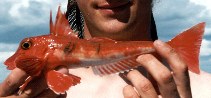
soft rays: 16 - 18. Head large, without deep occipital groove. First dorsal spine serrate anteriorly, second spine not elongate. Lateral line scales plate-like expanded vertically. Breast and anterior part of belly without scales. Vertebrae 36-37 (13-14 precaudal and 22-23 caudal). Pectoral fin with last 3 rays free. Snout steep, prolonged forward by a denticulated and bilobed flattened rostrum.
Occasionally forms schools. Found over sand and gravel, crag, and rocks in the continental shelf (Ref. 2723). Feeds on benthic crustaceans, other invertebrates and bottom-dwelling fishes (Ref.4697).
Richards, W.J. and V.P. Saksena, 1990. Triglidae. p. 680-684. In J.C. Quero, J.C. Hureau, C. Karrer, A. Post and L. Saldanha (eds.) Check-list of the fishes of the eastern tropical Atlantic (CLOFETA). JNICT, Lisbon; SEI, Paris; and UNESCO, Paris. Vol. 2. (Ref. 3687)
IUCN Red List Status (Ref. 130435)
Threat to humans
Harmless
Human uses
Fisheries: minor commercial
More information
ReferencesAquacultureAquaculture profileStrainsGeneticsElectrophoresesHeritabilityDiseasesProcessingNutrientsMass conversion
Tools
Special reports
Download XML
Internet sources
Estimates based on models
Preferred temperature (Ref.
123201): 7 - 15.8, mean 10.1 °C (based on 667 cells).
Phylogenetic diversity index (Ref.
82804): PD
50 = 0.5010 [Uniqueness, from 0.5 = low to 2.0 = high].
Bayesian length-weight: a=0.00794 (0.00661 - 0.00955), b=3.05 (3.00 - 3.10), in cm total length, based on LWR estimates for this species (Ref.
93245).
Trophic level (Ref.
69278): 3.8 ±0.1 se; based on diet studies.
Generation time: 3.0 (2.4 - 4.6) years. Estimated as median ln(3)/K based on 10
growth studies.
Resilience (Ref.
120179): Medium, minimum population doubling time 1.4 - 4.4 years (K=0.3; tm=2).
Prior r = 0.98, 95% CL = 0.64 - 1.47, Based on 1 stock assessment.
Fishing Vulnerability (Ref.
59153): Moderate to high vulnerability (46 of 100).
Nutrients (Ref.
124155): Calcium = 30 [18, 63] mg/100g; Iron = 0.36 [0.20, 0.67] mg/100g; Protein = 19 [18, 20] %; Omega3 = 0.964 [0.449, 2.684] g/100g; Selenium = 20.6 [11.3, 47.5] μg/100g; VitaminA = 10.5 [3.5, 29.8] μg/100g; Zinc = 0.443 [0.328, 0.630] mg/100g (wet weight);