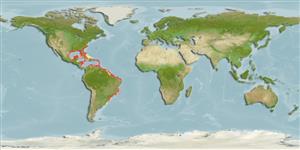
Environment: milieu / climate zone / depth range / distribution range
Ecology
Marine; reef-associated; depth range 10 - 140 m (Ref. 7251), usually 10 - 90 m (Ref. 5217). Tropical; 37°N - 34°S, 98°W - 34°W
Western Atlantic: North Carolina, USA and northern Gulf of Mexico to Brazil. Eastern Atlantic: Ascension Island (Ref. 26340).
Length at first maturity / Size / Weight / Age
Maturity: Lm ?, range 10 - ? cm
Max length : 30.0 cm TL male/unsexed; (Ref. 7251); common length : 20.0 cm TL male/unsexed; (Ref. 5217)
Predator which lives on the bottom where it hides partially or almost completely in the sand in order to disguise itself in the environment. Feeds on small fish and invertebrates. Exhibits sexual dimorphism (Ref. 35237). Marketed fresh (Ref. 5217).
Life cycle and mating behavior
Maturity | Reproduction | Spawning | Eggs | Fecundity | Larvae
Oviparous (Ref. 101737). Distinct pairing (Ref. 205). Females produce numerous eggs in multiple spawnings during a prolonged spawning period (Ref. 101737).
Robins, C.R. and G.C. Ray, 1986. A field guide to Atlantic coast fishes of North America. Houghton Mifflin Company, Boston, U.S.A. 354 p. (Ref. 7251)
IUCN Red List Status (Ref. 130435)
Threat to humans
Harmless
Human uses
Fisheries: minor commercial
More information
ReferencesAquacultureAquaculture profileStrainsGeneticsElectrophoresesHeritabilityDiseasesProcessingNutrientsMass conversion
Tools
Special reports
Download XML
Internet sources
Estimates based on models
Preferred temperature (Ref.
123201): 21.4 - 27.9, mean 25.6 °C (based on 874 cells).
Phylogenetic diversity index (Ref.
82804): PD
50 = 0.5039 [Uniqueness, from 0.5 = low to 2.0 = high].
Bayesian length-weight: a=0.00776 (0.00581 - 0.01037), b=3.07 (3.01 - 3.13), in cm total length, based on LWR estimates for this species (Ref.
93245).
Trophic level (Ref.
69278): 3.6 ±0.0 se; based on diet studies.
Resilience (Ref.
120179): High, minimum population doubling time less than 15 months (Preliminary K or Fecundity.).
Fishing Vulnerability (Ref.
59153): Low vulnerability (20 of 100).
Nutrients (Ref.
124155): Calcium = 62.3 [24.4, 124.4] mg/100g; Iron = 0.593 [0.270, 1.084] mg/100g; Protein = 17.2 [15.1, 19.5] %; Omega3 = 0.0916 [, ] g/100g; Selenium = 43.7 [22.6, 90.2] μg/100g; VitaminA = 45.5 [11.9, 188.3] μg/100g; Zinc = 0.971 [0.632, 1.435] mg/100g (wet weight);