Teleostei (teleosts) >
Eupercaria/misc (Various families in series Eupercaria) >
Haemulidae (Grunts) > Haemulinae
Etymology: Pomadasys: Greek, poma, -atos = cover, operculum + Greek, dasys = with hair (Ref. 45335).
More on author: Forsskål.
Environment: milieu / climate zone / depth range / distribution range
Ecology
Marine; freshwater; brackish; demersal; depth range 15 - 115 m (Ref. 12260). Tropical; 26°C - 29°C (Ref. 4959); 40°N - 27°S, 32°E - 170°E
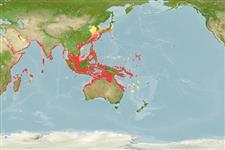
Indo-West Pacific: Red Sea to the Philippines (but without record from the Persian Gulf), north to southern Japan (Ref. 559), and south to northern Australia. Also reported from New Caledonia (Ref. 11889). Recently recorded from Oman (Ref. 11441) and Kuwait (Ref. 80050).
Size / Weight / Age
Maturity: Lm ? range ? - ? cm
Max length : 70.0 cm TL male/unsexed; (Ref. 48635); common length : 25.0 cm TL male/unsexed; (Ref. 5450)
Dorsal
spines
(total): 12;
Dorsal
soft rays
(total): 13-14;
Anal
spines: 3;
Anal
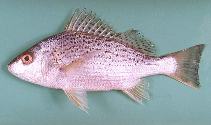
soft rays: 7. Body ovate; head profile almost straight. Mouth small; lips not thickened; two pores and a central groove under the chin. No antrorse spine before the dorsal fin origin; notch between the spinous and soft-rayed portion of the dorsal fin shallow. Color is generally silver-mauve to fawn above, white below. Small specimens with numerous spots aligned horizontally or fused into horizontal lines; large specimens plain or with scattered charcoal scale spots on back and upper sides; the snout is dark brown; the upper operculum charcoal or purplish.
Found in coastal waters (Ref. 30573, 48635). Enters freshwaters (4867). Marketed fresh, may be salted (Ref. 5284).
Life cycle and mating behavior
Maturity | Reproduction | Spawning | Eggs | Fecundity | Larvae
Oviparous, distinct pairing during breeding (Ref. 205).
McKay, R.J., 1984. Haemulidae. In W. Fischer and G. Bianchi (eds.) FAO species identification sheets for fishery purposes. Western Indian Ocean (Fishing Area 51). Vol. 2. FAO, Rome. pag. var. (Ref. 3412)
IUCN Red List Status (Ref. 130435)
Threat to humans
Harmless
Human uses
Fisheries: commercial
Tools
Special reports
Download XML
Internet sources
Estimates based on models
Preferred temperature (Ref.
123201): 23.2 - 28.5, mean 27.4 °C (based on 853 cells).
Phylogenetic diversity index (Ref.
82804): PD
50 = 0.5000 [Uniqueness, from 0.5 = low to 2.0 = high].
Bayesian length-weight: a=0.01380 (0.01117 - 0.01706), b=2.98 (2.94 - 3.02), in cm total length, based on LWR estimates for this species (Ref.
93245).
Trophic level (Ref.
69278): 3.5 ±0.3 se; based on diet studies.
Resilience (Ref.
120179): Medium, minimum population doubling time 1.4 - 4.4 years (K=0.2-0.5; tmax=19).
Fishing Vulnerability (Ref.
59153): Low to moderate vulnerability (31 of 100).
Climate Vulnerability (Ref.
125649): Very high vulnerability (81 of 100).
Nutrients (Ref.
124155): Calcium = 96.2 [20.9, 182.9] mg/100g; Iron = 0.981 [0.516, 1.813] mg/100g; Protein = 18.9 [17.0, 20.6] %; Omega3 = 0.238 [0.127, 0.403] g/100g; Selenium = 65.1 [37.7, 117.0] μg/100g; VitaminA = 13.5 [6.4, 26.2] μg/100g; Zinc = 1.11 [0.80, 1.56] mg/100g (wet weight);