Teleostei (teleosts) >
Gobiiformes (Gobies) >
Gobiidae (Gobies) > Gobionellinae
Etymology: Lepidogobius: Greek, lepis = scale + Latin, gobius = gudgeon (Ref. 45335); lepidus: From the Latin lepidus, meaning 'pretty' (Ref. 27436).
More on author: Girard.
Environment: milieu / climate zone / depth range / distribution range
Ecology
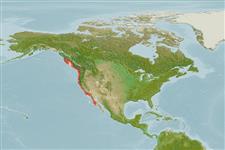
Marine; demersal; depth range 0 - 201 m (Ref. 2850). Subtropical; 55°N - 27°N, 136°W - 114°W
Eastern Pacific: Welcome Harbor, northern British Columbia, Canada to Isla Cedros, central Baja California, Mexico.
Size / Weight / Age
Maturity: Lm ? range ? - ? cm
Max length : 10.0 cm TL male/unsexed; (Ref. 2850); max. reported age: 7 years (Ref. 31146)
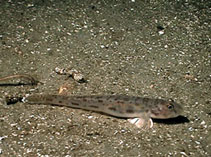
Found mostly on mud bottom; from intertidal to 201 m depth. Oviparous (Ref. 56079). Eggs are found attached to the walls of burrows (Ref. 56079).
Eschmeyer, W.N., E.S. Herald and H. Hammann, 1983. A field guide to Pacific coast fishes of North America. Boston (MA, USA): Houghton Mifflin Company. xii+336 p. (Ref. 2850)
IUCN Red List Status (Ref. 130435)
Threat to humans
Harmless
Human uses
More information
ReferencesAquacultureAquaculture profileStrainsGeneticsElectrophoresesHeritabilityDiseasesProcessingNutrientsMass conversion
Tools
Special reports
Download XML
Internet sources
Estimates based on models
Preferred temperature (Ref.
123201): 7.5 - 12, mean 9 °C (based on 54 cells).
Phylogenetic diversity index (Ref.
82804): PD
50 = 1.0000 [Uniqueness, from 0.5 = low to 2.0 = high].
Bayesian length-weight: a=0.00794 (0.00428 - 0.01474), b=3.07 (2.91 - 3.23), in cm total length, based on LWR estimates for this species & (Sub)family-body (Ref.
93245).
Trophic level (Ref.
69278): 3.4 ±0.4 se; based on size and trophs of closest relatives
Generation time: 8.5 ( na - na) years. Estimated as median ln(3)/K based on 1
growth studies.
Resilience (Ref.
120179): Medium, minimum population doubling time 1.4 - 4.4 years (K=0.13; tmax=7).
Fishing Vulnerability (Ref.
59153): Moderate to high vulnerability (51 of 100).