Teleostei (teleosts) >
Carangiformes (Jacks) >
Carangidae (Jacks and pompanos) > Caranginae
Etymology: Selene: Greek, selene = moon (Ref. 45335).
More on author: Gill.
Environment: milieu / climate zone / depth range / distribution range
Ecology
Marine; brackish; demersal; depth range 20 - 100 m (Ref. 4233), usually ? - 60 m (Ref. 57392). Subtropical; 39°N - 28°S
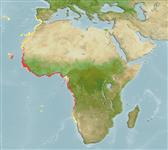
Eastern Atlantic Ocean: Madeira, Canarias, Cabo Verde and from Senegal to Namibia. Replaced by Selene setapinnis in western Atlantic. These two species have not been adequately studied and may prove to be conspecific.
Size / Weight / Age
Maturity: Lm ? range ? - ? cm
Max length : 40.0 cm TL male/unsexed; (Ref. 57392); common length : 24.0 cm FL male/unsexed; (Ref. 3195); max. published weight: 1.5 kg (Ref. 27584)
Dorsal
spines
(total): 9;
Dorsal
soft rays
(total): 23-24;
Anal
spines: 1-3;
Anal
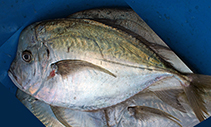
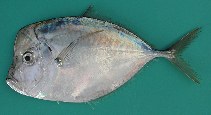
soft rays: 18 - 20. Diagnosis: body short, deep (depth comprised 1.7-2.3 times in fork length) and strongly compressed; head with a typical hump above eyes and a steep frontal profile that is slightly concave in front of eyes; lower jaw prominent; 2 dorsal fins, 1st with 8 spines that are very short in adults, 2nd with 1 spine and 23 or 24 soft rays; anal fin with 2 anterior detached spines (resorbed in adults), followed by 1 spine and 18-20 soft rays; anterior lobes of soft dorsal and anal fins small or indistinct; pelvic fins very short, nearly rudimentary; body (except breast) entirely covered with minute cycloid scales embedded in the skin; lateral line distinctly arched over pectoral fins, with some weak scutes on the straight posterior part; 2 lateral keels at base of caudal fin (Ref. 57392). Silvery with faint dusky opercular spot; juveniles with oval black spot over straight lateral line (Ref. 3197).
Coloration: entirely silvery with bluish reflections that are more pronounced on dorsal half; a blackish spot at upper angle of gill cover; in juveniles, another blackish spot on sides of body, at the inflexion point of the lateral line; fins hyaline (Ref. 57392).
Adults usually found near the bottom (Ref. 4233, 57392). Occasionally enters lagoons and estuaries, especially during juvenile stage (Ref. 57392). Juveniles occur in surface waters often near bays and river mouths (Ref. 4233). Form schools (Ref. 4233, 57392). Feed on crustaceans and small fishes (Ref. 4233). Eggs are pelagic (Ref. 4233).
Life cycle and mating behavior
Maturity | Reproduction | Spawning | Eggs | Fecundity | Larvae
Smith-Vaniz, W.F., 1986. Carangidae. p. 815-844. In P.J.P. Whitehead, M.-L. Bauchot, J.-C. Hureau, J. Nielsen and E. Tortonese (eds.) Fishes of the north-eastern Atlantic and the Mediterranean. UNESCO, Paris. vol. 2. (Ref. 4233)
IUCN Red List Status (Ref. 130435)
Threat to humans
Harmless
Human uses
Fisheries: commercial
More information
Common namesSynonymsMetabolismPredatorsEcotoxicologyReproductionMaturitySpawningSpawning aggregationFecundityEggsEgg development
ReferencesAquacultureAquaculture profileStrainsGeneticsElectrophoresesHeritabilityDiseasesProcessingNutrientsMass conversion
Tools
Special reports
Download XML
Internet sources
Estimates based on models
Preferred temperature (Ref.
123201): 18.3 - 25.9, mean 20.6 °C (based on 42 cells).
Phylogenetic diversity index (Ref.
82804): PD
50 = 0.5039 [Uniqueness, from 0.5 = low to 2.0 = high].
Bayesian length-weight: a=0.01479 (0.00861 - 0.02542), b=2.89 (2.75 - 3.03), in cm total length, based on LWR estimates for this species & (Sub)family-body (Ref.
93245).
Trophic level (Ref.
69278): 4.1 ±0.69 se; based on food items.
Generation time: 1.8 ( na - na) years. Estimated as median ln(3)/K based on 2
growth studies.
Resilience (Ref.
120179): High, minimum population doubling time less than 15 months (K=0.6).
Fishing Vulnerability (Ref.
59153): Low vulnerability (25 of 100).
Climate Vulnerability (Ref.
125649): Low to moderate vulnerability (35 of 100).
Nutrients (Ref.
124155): Calcium = 118 [67, 251] mg/100g; Iron = 1.51 [0.87, 2.91] mg/100g; Protein = 19.1 [17.3, 21.4] %; Omega3 = 0.468 [0.293, 0.802] g/100g; Selenium = 26.2 [13.7, 52.2] μg/100g; VitaminA = 8.85 [2.81, 26.09] μg/100g; Zinc = 0.768 [0.545, 1.101] mg/100g (wet weight);