Teleostei (teleosts) >
Eupercaria/misc (Various families in series Eupercaria) >
Labridae (Wrasses) > Corinae
Etymology: Thalassoma: Greek, thalassa = the sea + Greek, soma = body; the colour of the sea (Ref. 45335).
More on author: Bloch.
Environment: milieu / climate zone / depth range / distribution range
Ecology
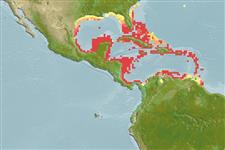
Marine; reef-associated; depth range 0 - 40 m (Ref. 9710), usually 3 - 30 m (Ref. 27115). Tropical; 23°C - 26°C (Ref. 27115); 34°N - 7°N, 99°W - 58°W
Western Atlantic: Bermuda, Florida (USA), southeastern Gulf of Mexico and throughout the Caribbean Sea to northern South America.
Size / Weight / Age
Maturity: Lm ? range ? - ? cm
Max length : 25.0 cm TL male/unsexed; (Ref. 26340); max. reported age: 3.00 years (Ref. 3420)
Short description
Morphology | Morphometrics
Dorsal
spines
(total): 8;
Dorsal
soft rays
(total): 12-13;
Anal
spines: 3;
Anal
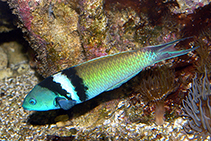
soft rays: 10 - 11. Body elongate; 3 primary color phases, the smallest with a black mid-lateral stripe which continues as pale red blotches on head; back above stripe yellow on reef fish and whitish on fish from inshore non-reef areas, and body below white. The largest phase, has a bright blue head and a green body with two broad vertical black bars anteriorly which are separated by a light blue interspace; this phase is always male. The small yellow phase with the black stripe may be either male or female (Ref. 13442).
Inhabits reef areas, inshore bays and seagrass beds. Feeds mainly on zooplankton and small benthic animals, but may also feed on ectoparasites of other fishes (Ref. 9626). Spawn at midday throughout the year (Ref. 26938). A protogynous hermaphrodite (Ref. 55367). Generally of no interest to fisheries because of its small average size (Ref. 5217).
Life cycle and mating behavior
Maturity | Reproduction | Spawning | Eggs | Fecundity | Larvae
A diandric species (Ref. 55367). Sex reversal is completed in more than 3-4 weeks (Ref. 34185, 34257). Length at sex change = 8.3 cm TL, forms leks during breeding (Ref. 55367).
Robins, C.R. and G.C. Ray, 1986. A field guide to Atlantic coast fishes of North America. Houghton Mifflin Company, Boston, U.S.A. 354 p. (Ref. 7251)
IUCN Red List Status (Ref. 130435)
Threat to humans
Harmless
Human uses
Aquarium: commercial
More information
ReferencesAquacultureAquaculture profileStrainsGeneticsElectrophoresesHeritabilityDiseasesProcessingNutrientsMass conversion
Tools
Special reports
Download XML
Internet sources
Estimates based on models
Preferred temperature (Ref.
123201): 25 - 28.1, mean 26.8 °C (based on 222 cells).
Phylogenetic diversity index (Ref.
82804): PD
50 = 0.5000 [Uniqueness, from 0.5 = low to 2.0 = high].
Bayesian length-weight: a=0.00891 (0.00512 - 0.01553), b=3.02 (2.87 - 3.17), in cm total length, based on LWR estimates for this species & Genus-body shape (Ref.
93245).
Trophic level (Ref.
69278): 3.3 ±0.1 se; based on diet studies.
Generation time: 1.5 ( na - na) years. Estimated as median ln(3)/K based on 1
growth studies.
Resilience (Ref.
120179): High, minimum population doubling time less than 15 months (k=0.7; tmax=3).
Fishing Vulnerability (Ref.
59153): Low vulnerability (20 of 100).
Nutrients (Ref.
124155): Calcium = 75.2 [45.5, 123.9] mg/100g; Iron = 0.761 [0.447, 1.351] mg/100g; Protein = 18.6 [15.8, 20.8] %; Omega3 = 0.149 [0.100, 0.227] g/100g; Selenium = 32 [20, 56] μg/100g; VitaminA = 77.7 [25.7, 279.6] μg/100g; Zinc = 1.51 [1.07, 2.36] mg/100g (wet weight);