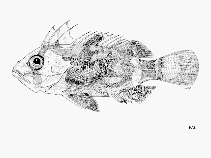
Environment: milieu / climate zone / depth range / distribution range
Ecology
Marine; demersal. Subtropical
Western Indian Ocean.
Size / Weight / Age
Maturity: Lm ? range ? - ? cm
Max length : 7.5 cm TL male/unsexed; (Ref. 13710)
Short description
Morphology | Morphometrics
Dorsal
spines
(total): 12;
Dorsal
soft rays
(total): 7;
Anal
spines: 3;
Anal
soft rays: 5 - 6. Body light brown, irregularly blotched with darker brown; a broad dark band across interorbital, continuing as a bar below eye and another band from origin of dorsal fin to eye. Dorsal fin pale with a large dark brown blotch in middle of the fin, usually between 6th and 9th spines; other irregular blotches especially posteriorly. Caudal fin whitish with faint small dark spots. No scales. Body depth 2.45-3.1 in SL. Lacrimal with 2 spines, a short ventral one and a large posterior one that extends to below center of eye. Preopercle with a large spine in line with suborbital ridge; the second spine, lower, very small and blunt. Origin of dorsal fin above rear edge of eye; a broad space between 3rd and 4th dorsal spines, the associated membrane deeply incised, nearly dividing the dorsal into 2 fins. Caudal fin truncate, slightly rounded when spread (Ref. 11441).
Found inshore on sandy bottoms, often in bays.
Life cycle and mating behavior
Maturity | Reproduction | Spawning | Eggs | Fecundity | Larvae
Carpenter, K.E., F. Krupp, D.A. Jones and U. Zajonz, 1997. FAO species identification field guide for fishery purposes. Living marine resources of Kuwait, eastern Saudi Arabia, Bahrain, Qatar, and the United Arab Emirates. FAO, Rome. 293 p. (Ref. 13710)
IUCN Red List Status (Ref. 130435)
Threat to humans
Venomous
Human uses
More information
Common namesSynonymsMetabolismPredatorsEcotoxicologyReproductionMaturitySpawningSpawning aggregationFecundityEggsEgg development
Age/SizeGrowthLength-weightLength-lengthLength-frequenciesMorphometricsMorphologyLarvaeLarval dynamicsRecruitmentAbundanceBRUVS
ReferencesAquacultureAquaculture profileStrainsGeneticsElectrophoresesHeritabilityDiseasesProcessingNutrientsMass conversion
Tools
Special reports
Download XML
Internet sources
Estimates based on models
Phylogenetic diversity index (Ref.
82804): PD
50 = 1.0000 [Uniqueness, from 0.5 = low to 2.0 = high].
Bayesian length-weight: a=0.01905 (0.00780 - 0.04657), b=3.03 (2.82 - 3.24), in cm total length, based on LWR estimates for this (Sub)family-body shape (Ref.
93245).
Trophic level (Ref.
69278): 3.1 ±0.3 se; based on size and trophs of closest relatives
Resilience (Ref.
120179): High, minimum population doubling time less than 15 months (Preliminary K or Fecundity.).
Fishing Vulnerability (Ref.
59153): Low vulnerability (10 of 100).