Environment: milieu / climate zone / depth range / distribution range
Ecology
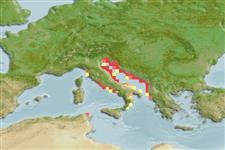
Marine; freshwater; brackish; demersal; anadromous (Ref. 51243); depth range 10 - 40 m (Ref. 93286). Temperate; 46°N - 37°N, 10°E - 20°E
Europe: Adriatic Sea and its tributaries between Po (Italy) and Buna (Albania) drainages. Recorded from Corfu; present in lowermost part of Adriatic rivers from Soca to Drin. Records from Tyrrhenian slope of Italy, Spain and France are erroneous.
Size / Weight / Age
Maturity: Lm ? range ? - ? cm
Max length : 200 cm TL male/unsexed; (Ref. 3397); max. published weight: 25.0 kg (Ref. 3193)
Short description
Morphology | Morphometrics
Dorsal
spines
(total): 0;
Dorsal
soft rays
(total): 36-48;
Anal
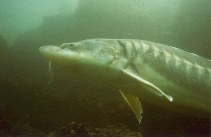
soft rays: 24 - 31. Snout moderate, very broad and rounded at tip. Lower lip continuous, interrupted at center. Barbels nearer to tip of snout than to mouth and not touching it. Five rows of scutes, dorsal 10-14 (the middle ones deeper and usually larger than those at front), lateral 32-42 on each side, ventral 8-11 on each side, with no smaller plates between dorsal and lateral rows. Back is olivaceous brown, flanks lighter, belly white.
Occurs in the sea close to shore and estuaries, not entering pure marine waters. In freshwater, it inhabits large deep rivers (Ref. 59043). A long-lived species which is found mainly over sand and mud. Feeds on bottom-living invertebrates and small fishes. Reproduction takes place from May to July. Is threatened by habitat destruction, pollution and overfishing (Ref. 26100). The flesh is used for food (Ref. 6866) and eggs used for caviar production (Ref. 128183).
Enters rivers from March to May, and presumably spawns then.
Kottelat, M. and J. Freyhof, 2007. Handbook of European freshwater fishes. Publications Kottelat, Cornol and Freyhof, Berlin. 646 pp. (Ref. 59043)
IUCN Red List Status (Ref. 130435)
Threat to humans
Harmless
Human uses
Fisheries: commercial
More information
ReferencesAquacultureAquaculture profileStrainsGeneticsElectrophoresesHeritabilityDiseasesProcessingNutrientsMass conversion
Tools
Special reports
Download XML
Internet sources
Estimates based on models
Preferred temperature (Ref.
123201): 14.7 - 18.2, mean 17.4 °C (based on 12 cells).
Phylogenetic diversity index (Ref.
82804): PD
50 = 0.5000 [Uniqueness, from 0.5 = low to 2.0 = high].
Bayesian length-weight: a=0.00324 (0.00142 - 0.00736), b=3.17 (2.99 - 3.35), in cm total length, based on LWR estimates for this Genus-body shape (Ref.
93245).
Trophic level (Ref.
69278): 3.4 ±0.50 se; based on food items.
Resilience (Ref.
120179): Very Low, minimum population doubling time more than 14 years (Preliminary K or Fecundity.).
Fishing Vulnerability (Ref.
59153): Very high vulnerability (90 of 100).
Nutrients (Ref.
124155): Calcium = 16.9 [10.0, 29.8] mg/100g; Iron = 0.256 [0.156, 0.410] mg/100g; Protein = 17.5 [14.9, 20.1] %; Omega3 = 0.33 [0.18, 0.59] g/100g; Selenium = 18.3 [9.3, 35.5] μg/100g; VitaminA = 6.4 [2.3, 17.8] μg/100g; Zinc = 0.53 [0.38, 0.73] mg/100g (wet weight);