Teleostei (teleosts) >
Scombriformes (Mackerels) >
Bramidae (Pomfrets)
Etymology: Brama: Old French, breme, bresme = a fresh water fish; 1460 (Ref. 45335).
Environment: milieu / climate zone / depth range / distribution range
Ecology
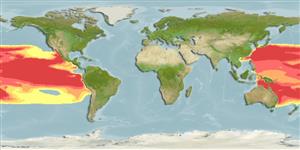
Marine; pelagic-oceanic; depth range 1 - 200 m (Ref. 58302). Temperate
Western Pacific (Ref. 559). Reported from the Hawaiian Islands (Ref. 58302).
Size / Weight / Age
Maturity: Lm ? range ? - ? cm
Dorsal
spines
(total): 0;
Dorsal
soft rays
(total): 33;
Anal
spines: 0;
Anal
soft rays: 27;
Vertebrae: 40. This description is base on a 4.9 cm SL specimen caught near Ogasawara Islands, Japan. Body strongly compressed. Pectoral fin situated relatively high on body. Posterior margin of preoperculum serrated.
Known only from young and juvenile specimens.
Life cycle and mating behavior
Maturity | Reproduction | Spawning | Eggs | Fecundity | Larvae
Masuda, H., K. Amaoka, C. Araga, T. Uyeno and T. Yoshino, 1984. The fishes of the Japanese Archipelago. Vol. 1. Tokai University Press, Tokyo, Japan. 437 p. (text). (Ref. 559)
IUCN Red List Status (Ref. 130435)
Threat to humans
Harmless
Human uses
More information
Common namesSynonymsMetabolismPredatorsEcotoxicologyReproductionMaturitySpawningSpawning aggregationFecundityEggsEgg development
ReferencesAquacultureAquaculture profileStrainsGeneticsElectrophoresesHeritabilityDiseasesProcessingNutrientsMass conversion
Tools
Special reports
Download XML
Internet sources
Estimates based on models
Preferred temperature (Ref.
123201): 19.6 - 28.2, mean 26.1 °C (based on 126 cells).
Phylogenetic diversity index (Ref.
82804): PD
50 = 0.5039 [Uniqueness, from 0.5 = low to 2.0 = high].
Bayesian length-weight: a=0.01820 (0.00782 - 0.04232), b=2.96 (2.76 - 3.16), in cm total length, based on LWR estimates for this (Sub)family-body shape (Ref.
93245).
Trophic level (Ref.
69278): 4.0 ±0.6 se; based on size and trophs of closest relatives
Resilience (Ref.
120179): Medium, minimum population doubling time 1.4 - 4.4 years (Preliminary K or Fecundity.).
Fishing Vulnerability (Ref.
59153): Moderate vulnerability (36 of 100).