Teleostei (teleosts) >
Carangiformes (Jacks) >
Carangidae (Jacks and pompanos) > Caranginae
Etymology: Hemicaranx: Greek, hemi = the half + French, carangue, the name of a Caribbean fish; 1836 (Ref. 45335).
More on author: Gilbert.
Environment: milieu / climate zone / depth range / distribution range
Ecology
Marine; brackish; benthopelagic. Tropical; 33°N - 20°S
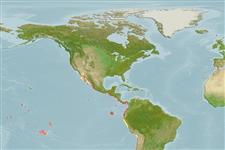
Eastern Central Pacific: Baja California, Mexico to Peru (Ref. 5530).
Size / Weight / Age
Maturity: Lm ? range ? - ? cm
Max length : 35.0 cm TL male/unsexed; (Ref. 55763); common length : 20.0 cm FL male/unsexed; (Ref. 9283); max. published weight: 364.00 g (Ref. 124487)
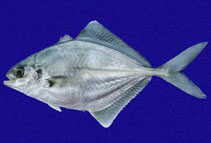
Body sub-oval and compressed; both jaws with a single row of small, comb-like teeth; pectoral fins falcate and relatively sort (from 3.5 to 4.5 times in total length); back silvery blue; belly and flanks white or silvery; pectoral fins darker (Ref. 55763).
Adults are found in coastal waters, also entering brackish waters (Ref. 9283). Marketed fresh and salted or dried (Ref.9283).
Life cycle and mating behavior
Maturity | Reproduction | Spawning | Eggs | Fecundity | Larvae
Smith-Vaniz, W.F., 1995. Carangidae. Jureles, pámpanos, cojinúas, zapateros, cocineros, casabes, macarelas, chicharros, jorobados, medregales, pez pilota. p. 940-986. In W. Fischer, F. Krupp, W. Schneider, C. Sommer, K.E. Carpenter and V. Niem (eds.) Guia FAO para Identification de Especies para lo Fines de la Pesca. Pacifico Centro-Oriental. 3 Vols. FAO, Rome. (Ref. 9283)
IUCN Red List Status (Ref. 130435)
Threat to humans
Harmless
Human uses
Fisheries: minor commercial; gamefish: yes
More information
Common namesSynonymsMetabolismPredatorsEcotoxicologyReproductionMaturitySpawningSpawning aggregationFecundityEggsEgg development
ReferencesAquacultureAquaculture profileStrainsGeneticsElectrophoresesHeritabilityDiseasesProcessingNutrientsMass conversion
Tools
Special reports
Download XML
Internet sources
Estimates based on models
Preferred temperature (Ref.
123201): 20.6 - 28.4, mean 25.6 °C (based on 64 cells).
Phylogenetic diversity index (Ref.
82804): PD
50 = 0.5625 [Uniqueness, from 0.5 = low to 2.0 = high].
Bayesian length-weight: a=0.01349 (0.00646 - 0.02815), b=2.96 (2.79 - 3.13), in cm total length, based on LWR estimates for this (Sub)family-body shape (Ref.
93245).
Trophic level (Ref.
69278): 3.7 ±0.6 se; based on size and trophs of closest relatives
Resilience (Ref.
120179): High, minimum population doubling time less than 15 months (Preliminary K or Fecundity.).
Fishing Vulnerability (Ref.
59153): Low vulnerability (25 of 100).
Nutrients (Ref.
124155): Calcium = 137 [85, 300] mg/100g; Iron = 1.19 [0.70, 2.30] mg/100g; Protein = 18.7 [17.5, 19.8] %; Omega3 = 0.274 [0.147, 0.518] g/100g; Selenium = 50.2 [27.2, 96.1] μg/100g; VitaminA = 26.1 [8.1, 68.2] μg/100g; Zinc = 1.38 [0.96, 1.96] mg/100g (wet weight);