Teleostei (teleosts) >
Clupeiformes (Herrings) >
Engraulidae (Anchovies) > Engraulinae
Etymology: Anchoa: Italian ancioa = anchovy (Ref. 45335).
More on author: Poey.
Environment: milieu / climate zone / depth range / distribution range
Ecology
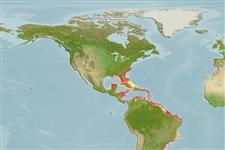
Marine; pelagic-neritic; depth range 0 - 60 m (Ref. 189). Subtropical; 36°N - 30°S, 91°W - 32°W (Ref. 189)
Western Atlantic: North Carolina, USA to northern Gulf of Mexico; Cuba and probably throughout the Greater and Lesser Antilles; Yucatan, Mexico to at least Santos, Brazil.
Size / Weight / Age
Maturity: Lm ? range ? - ? cm
Max length : 10.0 cm TL male/unsexed; (Ref. 5217); common length : 8.0 cm TL male/unsexed; (Ref. 5217)
Dorsal
spines
(total): 0;
Anal
spines: 0;
Anal
soft rays: 16 - 21. Snout pointed about 3/4 eye diameter; maxilla long, tip pointed, projecting at least 1/2 eye diameter beyond second supra-maxilla, reaching beyond hind border of pre-operculum; gill cover canals of walkeri-type. Anal fin origin below midpoint of dorsal fin base; anus nearer to pelvic fin tips than to anal fin origin. Silver stripe along flank, about pupil diameter, lost on preservation.
Occurs in coastal waters, forming dense schools along beaches in water of 1 m or less.
Life cycle and mating behavior
Maturity | Reproduction | Spawning | Eggs | Fecundity | Larvae
Spawn in school (Ref. 205).
Whitehead, P.J.P., G.J. Nelson and T. Wongratana, 1988. FAO Species Catalogue. Vol. 7. Clupeoid fishes of the world (Suborder Clupeoidei). An annotated and illustrated catalogue of the herrings, sardines, pilchards, sprats, shads, anchovies and wolf-herrings. FAO Fish. Synop. 125(7/2):305-579. Rome: FAO. (Ref. 189)
IUCN Red List Status (Ref. 130435)
Threat to humans
Harmless
Human uses
Fisheries: subsistence fisheries; bait: usually
More information
ReferencesAquacultureAquaculture profileStrainsGeneticsElectrophoresesHeritabilityDiseasesProcessingNutrientsMass conversion
Tools
Special reports
Download XML
Internet sources
Estimates based on models
Preferred temperature (Ref.
123201): 22.7 - 28, mean 25.9 °C (based on 308 cells).
Phylogenetic diversity index (Ref.
82804): PD
50 = 0.5000 [Uniqueness, from 0.5 = low to 2.0 = high].
Bayesian length-weight: a=0.00513 (0.00232 - 0.01135), b=3.14 (2.96 - 3.32), in cm total length, based on LWR estimates for this Genus-body shape (Ref.
93245).
Trophic level (Ref.
69278): 3.3 ±0.4 se; based on size and trophs of closest relatives
Resilience (Ref.
120179): High, minimum population doubling time less than 15 months (Preliminary K or Fecundity.).
Fishing Vulnerability (Ref.
59153): Low vulnerability (10 of 100).