Teleostei (teleosts) >
Syngnathiformes (Pipefishes and seahorses) >
Syngnathidae (Pipefishes and seahorses) > Syngnathinae
Etymology: Acentronura: Greek, a = without + Greek, kentron = sting + Greek, oura = tail (Ref. 45335).
More on author: Günther.
Environment: milieu / climate zone / depth range / distribution range
Ecology
Marine; reef-associated; depth range 1 - 20 m (Ref. 48635). Tropical
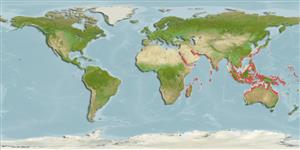
Indo-West Pacific: northern Red Sea and Mozambique to Torres Straits and Queensland, Australia. Also reported from Persian Gulf (Ref. 68964).
Size / Weight / Age
Maturity: Lm ? range ? - ? cm
Max length : 6.3 cm TL male/unsexed; (Ref. 4281)
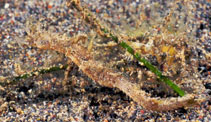
Typically found on small and sparse seagrass or algae that grow adjacent to reefs at shallow to moderate depths. Usually found in pairs (Ref. 48635). Ovoviviparous (Ref. 205). The male carries the eggs in a brood pouch which is found under the tail (Ref. 205).
Life cycle and mating behavior
Maturity | Reproduction | Spawning | Eggs | Fecundity | Larvae
Male carries the eggs in a brood pouch (Ref. 205).
Dawson, C.E., 1986. Syngnathidae. p. 445-458. In M.M. Smith and P.C. Heemstra (eds.) Smiths' sea fishes. Springer-Verlag, Berlin. (Ref. 4281)
IUCN Red List Status (Ref. 130435)
Threat to humans
Harmless
Human uses
More information
Age/SizeGrowthLength-weightLength-lengthLength-frequenciesMorphometricsMorphologyLarvaeLarval dynamicsRecruitmentAbundanceBRUVS
ReferencesAquacultureAquaculture profileStrainsGeneticsElectrophoresesHeritabilityDiseasesProcessingNutrientsMass conversion
Tools
Special reports
Download XML
Internet sources
Estimates based on models
Preferred temperature (Ref.
123201): 24.9 - 29.3, mean 28.5 °C (based on 3288 cells).
Phylogenetic diversity index (Ref.
82804): PD
50 = 0.6250 [Uniqueness, from 0.5 = low to 2.0 = high].
Bayesian length-weight: a=0.00389 (0.00180 - 0.00842), b=3.12 (2.94 - 3.30), in cm total length, based on all LWR estimates for this body shape (Ref.
93245).
Trophic level (Ref.
69278): 3.2 ±0.4 se; based on size and trophs of closest relatives
Resilience (Ref.
120179): High, minimum population doubling time less than 15 months (Preliminary K or Fecundity.).
Fishing Vulnerability (Ref.
59153): Low vulnerability (10 of 100).