Teleostei (teleosts) >
Clupeiformes (Herrings) >
Dorosomatidae (Gizzard shads and sardinellas)
Etymology: Konosirus: Japanese, konoshiro, a fish eaten in Kumihama City, in the Sea of Japan.
More on authors: Temminck & Schlegel.
Environment: milieu / climate zone / depth range / distribution range
Ecology
Marine; brackish; pelagic-neritic; oceanodromous (Ref. 51243). Subtropical; 42°N - 23°N, 117°E - 138°E (Ref. 54453)
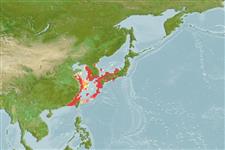
Indo-West Pacific: coasts of Japan from about 38°N southward; Sea of Japan north to Vladivostok on mainland; also Yellow Sea, including Gulf of Pohai and East China Sea south to Taiwan Island and Hong Kong).
Length at first maturity / Size / Weight / Age
Maturity: Lm ?, range 15 - ? cm
Max length : 32.0 cm TL male/unsexed; (Ref. 593)
Dorsal
spines
(total): 0;
Anal
spines: 0;
Anal
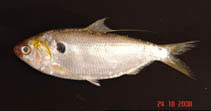
soft rays: 192 - 27. Body moderately slender, moderately compressed, belly with 17 to 21 (usually 19 or 20) + 12 to 16 (usually 14 or 15), total 32 to 37 (usually 34 or 35) scutes; no pre-dorsal scutes. Snout projecting slightly; gill rakers of first arch at least 3/4 length of gill filaments. Vertebrae 46 to 51 (usually 49, also 48 or 51). A dark spot behind gill opening, followed by several lines of dark dots.
Found off coasts and in bays, but migrating into shallower brackish water for breeding, at least in Ariake Sound (south Kyushu), where spawning takes place far up the Sound in April and May. Individuals apparently spawn twice or more during the season.
Whitehead, P.J.P., 1985. FAO Species Catalogue. Vol. 7. Clupeoid fishes of the world (suborder Clupeoidei). An annotated and illustrated catalogue of the herrings, sardines, pilchards, sprats, shads, anchovies and wolf-herrings. FAO Fish. Synop. 125(7/1):1-303. Rome: FAO. (Ref. 188)
IUCN Red List Status (Ref. 130435)
Threat to humans
Harmless
Human uses
Fisheries: minor commercial
More information
ReferencesAquacultureAquaculture profileStrainsGeneticsElectrophoresesHeritabilityDiseasesProcessingNutrientsMass conversion
Tools
Special reports
Download XML
Internet sources
Estimates based on models
Preferred temperature (Ref.
123201): 16.1 - 23.8, mean 20.3 °C (based on 86 cells).
Phylogenetic diversity index (Ref.
82804): PD
50 = 1.0000 [Uniqueness, from 0.5 = low to 2.0 = high].
Bayesian length-weight: a=0.00912 (0.00601 - 0.01383), b=3.04 (2.92 - 3.16), in cm total length, based on LWR estimates for this species & (Sub)family-body (Ref.
93245).
Trophic level (Ref.
69278): 2.9 ±0.24 se; based on food items.
Resilience (Ref.
120179): High, minimum population doubling time less than 15 months (Assuming tm=1).
Fishing Vulnerability (Ref.
59153): Moderate vulnerability (36 of 100).
Climate Vulnerability (Ref.
125649): High to very high vulnerability (65 of 100).
Nutrients (Ref.
124155): Calcium = 99.3 [58.4, 169.9] mg/100g; Iron = 1.61 [0.98, 2.68] mg/100g; Protein = 19.4 [18.3, 20.4] %; Omega3 = 0.587 [0.361, 0.921] g/100g; Selenium = 18.9 [10.5, 35.0] μg/100g; VitaminA = 21.3 [8.9, 51.4] μg/100g; Zinc = 1.13 [0.80, 1.60] mg/100g (wet weight);