Teleostei (teleosts) >
Scombriformes (Mackerels) >
Scombridae (Mackerels, tunas, bonitos) > Scombrinae
Etymology: Scomberomorus: Latin, scomber = mackerel + Greek, moros = silly, stupid (Ref. 45335).
More on author: Cuvier.
Environment: milieu / climate zone / depth range / distribution range
Ecology
Marine; brackish; pelagic-neritic; oceanodromous (Ref. 51243); depth range 1 - 40 m (Ref. 28173), usually 20 - 25 m (Ref. 28173). Tropical; 45°N - 19°S, 24°W - 14°E (Ref. 168)
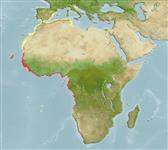
Eastern Atlantic: Canary Islands and Senegal to the Gulf of Guinea and Baía dos Tigres, Angola. Rarely found in the northern Mediterranean Sea, along the coasts of France and Italy. This species has been erroneously been considered as a synonym of Scomberomorus maculatus by many authors.
Length at first maturity / Size / Weight / Age
Maturity: Lm 37.3, range 33 - 45 cm
Max length : 100.0 cm TL male/unsexed; (Ref. 2683); 98.0 cm FL (female); common length : 75.0 cm TL male/unsexed; (Ref. 2683); max. published weight: 6.0 kg (Ref. 40637); max. reported age: 5 years (Ref. 27160)
Dorsal
spines
(total): 15 - 18;
Dorsal
soft rays
(total): 0;
Anal
soft rays: 17 - 20;
Vertebrae: 46 - 47. Interpelvic process small and bifid. Body covered with small scales. Lateral line gradually curving down toward caudal peduncle. Intestine with 2 folds and 3 limbs. Swim bladder absent. Some large individuals with thin vertical bars. Anterior half of first dorsal fin and margin of posterior half of first fin black.
Inhabits warm waters (Ref. 2683). Forms school close to the shore (Ref. 9987). Enters coastal lagoons and feeds on clupeids particularly Ethmalosa fimbriata. Reproduces in July to August (Ref. 5377). Eggs and larvae are pelagic (Ref. 6769). Utilized fresh, dried-salted, smoked and frozen (Ref. 9987).
Collette, B.B. and C.E. Nauen, 1983. FAO Species Catalogue. Vol. 2. Scombrids of the world. An annotated and illustrated catalogue of tunas, mackerels, bonitos and related species known to date. Rome: FAO. FAO Fish. Synop. 125(2):137 p. (Ref. 168)
IUCN Red List Status (Ref. 130435)
Threat to humans
Harmless
Human uses
Fisheries: commercial
More information
ReferencesAquacultureAquaculture profileStrainsGeneticsElectrophoresesHeritabilityDiseasesProcessingNutrientsMass conversion
Tools
Special reports
Download XML
Internet sources
Estimates based on models
Preferred temperature (Ref.
123201): 22.7 - 27.7, mean 25.9 °C (based on 10 cells).
Phylogenetic diversity index (Ref.
82804): PD
50 = 0.5000 [Uniqueness, from 0.5 = low to 2.0 = high].
Bayesian length-weight: a=0.00851 (0.00482 - 0.01503), b=3.00 (2.85 - 3.15), in cm total length, based on LWR estimates for this species & Genus-body shape (Ref.
93245).
Trophic level (Ref.
69278): 4.4 ±0.8 se; based on diet studies.
Generation time: 3.5 ( na - na) years. Estimated as median ln(3)/K based on 2
growth studies.
Resilience (Ref.
120179): Medium, minimum population doubling time 1.4 - 4.4 years (K=0.31-0.33; tmax=5; Fec=1 million).
Prior r = 0.39, 95% CL = 0.26 - 0.59, Based on 1 stock assessment.
Fishing Vulnerability (Ref.
59153): Moderate vulnerability (38 of 100).
Climate Vulnerability (Ref.
125649): High vulnerability (60 of 100).
Nutrients (Ref.
124155): Calcium = 31.4 [14.7, 118.1] mg/100g; Iron = 0.768 [0.360, 1.957] mg/100g; Protein = 20.9 [19.6, 22.0] %; Omega3 = 0.257 [0.156, 0.423] g/100g; Selenium = 45.4 [17.0, 180.9] μg/100g; VitaminA = 23.7 [5.1, 110.0] μg/100g; Zinc = 0.793 [0.523, 1.256] mg/100g (wet weight);