Teleostei (teleosts) >
Eupercaria/misc (Various families in series Eupercaria) >
Labridae (Wrasses) > Cheilininae
Etymology: Cirrhilabrus: Latin, cirrus = curl fringe + Greek, labros = furious (Ref. 45335).
More on authors: Randall & Lubbock.
Environment: milieu / climate zone / depth range / distribution range
Ecology
Marine; reef-associated; depth range 1 - 55 m (Ref. 86942). Tropical
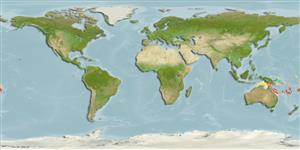
Western Central Pacific: New Caledonia and the Loyalty Islands to the Great Barrier Reef.
Size / Weight / Age
Maturity: Lm ? range ? - ? cm
Max length : 12.0 cm TL male/unsexed; (Ref. 2334)
Dorsal
spines
(total): 11;
Dorsal
soft rays
(total): 9;
Anal
spines: 3;
Anal
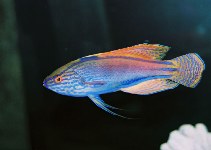
soft rays: 9. Trunk is lavender-pink, suffused with yellow dorsally, shading to pale yellow or white ventrally, with longitudinal rows of purple spots and dashes and a solid purple stripe along the back (and belly in males); median fins yellow with blue markings.
Inhabits clear outer reef slopes (Ref. 9710).
Life cycle and mating behavior
Maturity | Reproduction | Spawning | Eggs | Fecundity | Larvae
Distinct pairing during breeding (Ref. 205).
Randall, J.E. and R. Lubbock, 1982. Three new labrid fishes of the genus Cirrhilabrus from the southwestern Pacific. Occ. Pap. Ber. P. Bishop Mus. 25(2):12 p. (Ref. 9060)
IUCN Red List Status (Ref. 130435)
Threat to humans
Harmless
Human uses
Aquarium: commercial
More information
ReferencesAquacultureAquaculture profileStrainsGeneticsElectrophoresesHeritabilityDiseasesProcessingNutrientsMass conversion
Tools
Special reports
Download XML
Internet sources
Estimates based on models
Preferred temperature (Ref.
123201): 25.4 - 27.9, mean 26.5 °C (based on 102 cells).
Phylogenetic diversity index (Ref.
82804): PD
50 = 0.5000 [Uniqueness, from 0.5 = low to 2.0 = high].
Bayesian length-weight: a=0.01585 (0.00707 - 0.03555), b=2.95 (2.76 - 3.14), in cm total length, based on LWR estimates for this (Sub)family-body shape (Ref.
93245).
Trophic level (Ref.
69278): 3.4 ±0.4 se; based on size and trophs of closest relatives
Resilience (Ref.
120179): High, minimum population doubling time less than 15 months (Preliminary K or Fecundity.).
Fishing Vulnerability (Ref.
59153): Low vulnerability (10 of 100).
Nutrients (Ref.
124155): Calcium = 101 [59, 192] mg/100g; Iron = 0.897 [0.514, 1.709] mg/100g; Protein = 18.3 [15.3, 20.4] %; Omega3 = 0.172 [0.101, 0.290] g/100g; Selenium = 25 [14, 49] μg/100g; VitaminA = 232 [70, 832] μg/100g; Zinc = 1.68 [1.11, 2.62] mg/100g (wet weight);