Elasmobranchii (sharks and rays) >
Myliobatiformes (Stingrays) >
Potamotrygonidae (River stingrays) > Styracurinae
Etymology: Styracura: From Greek στυραξ (= (styrax), meaning "spine at the butt end of a spear" (Brown, 1954), and
ουρα (=oura) meaning tail, a suffix commonly used since Müller & Henle (1837) for whiptailed stingrays; referring to its greatly elongated caudal stings.; schmardae: Named for Ludwig Karl Schmarda (23 August 1819-7 April 1908), zoologist, explorer and founder of the zoological museum of the University of Graz, and later professor in the Zoological Institute of the University of Vienna (1861-1883) (Ref. 112396).
Environment: milieu / climate zone / depth range / distribution range
Ecology
Marine; demersal. Tropical
Western Central Atlantic: Gulf of Campeche and the West Indies to Suriname (Ref. 3168); including Brazil (Ref. 53430). Validity of this species questioned in Compagno's 1999 checklist (Ref. 35766).
Size / Weight / Age
Maturity: Lm ? range ? - ? cm
Max length : 200 cm WD male/unsexed; (Ref. 5217); common length : 100.0 cm WD male/unsexed; (Ref. 5217)
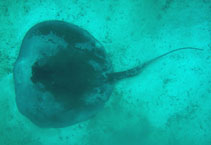
Disc ovate, broadly rounded. Tails with blunt tubercles. Upper surface dark brown, sooty olive. Edges of disc darker. Lower surface of disc and pelvic fins yellowish or cream white. Teeth little darker than lower surface (Ref. 6902).
Found on sandy bottoms, occasionally near coral reefs (Ref. 12951). Ovoviviparous (Ref. 50449). Marketed salted; also used in the preparation of gelatin and oil.
Life cycle and mating behavior
Maturity | Reproduction | Spawning | Eggs | Fecundity | Larvae
Exhibit ovoviparity (aplacental viviparity), with embryos feeding initially on yolk, then receiving additional nourishment from the mother by indirect absorption of uterine fluid enriched with mucus, fat or protein through specialised structures (Ref. 50449). Distinct pairing with embrace (Ref. 205). Distinct pairing with embrace (Ref. 205).
Stehmann, M., J.D. McEachran and R. Vergara R., 1978. Dasyatidae. In W. Fischer (ed.) FAO species identification sheets for fishery purposes. Western Central Atlantic (Fishing Area 31). Vol. 1. [pag. var.]. FAO, Rome. (Ref. 3168)
IUCN Red List Status (Ref. 130435)
Human uses
Fisheries: minor commercial
More information
ReferencesAquacultureAquaculture profileStrainsGeneticsElectrophoresesHeritabilityDiseasesProcessingNutrientsMass conversion
Tools
Special reports
Download XML
Internet sources
Estimates based on models
Preferred temperature (Ref.
123201): 26.6 - 28.1, mean 27.5 °C (based on 146 cells).
Phylogenetic diversity index (Ref.
82804): PD
50 = 0.5000 [Uniqueness, from 0.5 = low to 2.0 = high].
Bayesian length-weight: a=0.01000 (0.00244 - 0.04107), b=3.04 (2.81 - 3.27), in cm total length, based on all LWR estimates for this body shape (Ref.
93245).
Trophic level (Ref.
69278): 3.2 ±0.4 se; based on size and trophs of closest relatives
Resilience (Ref.
120179): Low, minimum population doubling time 4.5 - 14 years (Assuming fecundity<100).
Fishing Vulnerability (Ref.
59153): Very high vulnerability (90 of 100).
Nutrients (Ref.
124155): Calcium = 13.6 [2.0, 252.8] mg/100g; Iron = 0.646 [0.057, 7.729] mg/100g; Protein = 20.6 [18.1, 23.2] %; Omega3 = 0.11 [0.03, 0.33] g/100g; Selenium = 53.9 [11.2, 288.5] μg/100g; VitaminA = 5.07 [0.40, 53.26] μg/100g; Zinc = 0.633 [0.037, 7.414] mg/100g (wet weight);