Teleostei (teleosts) >
Carangaria/misc (Various families in series Carangaria) >
Sphyraenidae (Barracudas)
Etymology: Sphyraena: Greek, sphyraina, -es = the name of a fish (Ref. 45335).
More on author: Cuvier.
Environment: milieu / climate zone / depth range / distribution range
Ecology
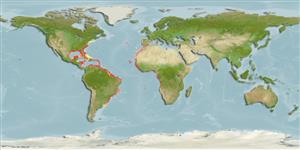
Marine; brackish; pelagic-neritic; depth range 0 - 100 m (Ref. 26999). Subtropical; 43°N - 37°S, 98°W - 14°E
Western Atlantic: Massachusetts (USA), northern Gulf of Mexico, and throughout the Caribbean Sea to Brazil. Eastern Atlantic: Senegal to Angola, including the Canary Islands and Cape Verde.
Length at first maturity / Size / Weight / Age
Maturity: Lm ?, range 35 - ? cm
Max length : 200 cm TL male/unsexed; (Ref. 27000); common length : 70.0 cm TL male/unsexed; (Ref. 5217); max. published weight: 1.8 kg (Ref. 57401)
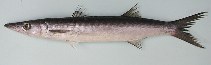
Occurs in shallow and generally turbid coastal water over muddy bottoms, often around river estuaries. Schooling species (Ref. 6949). Occasionally enters estuaries and brackish waters (Ref. 57401). Feeds on mainly on fishes belonging to the Engraulidae, Clupeidae, Lutjanidae and Synodontidae families and also on squid from the Loliginidae family (Ref. 9626). Maximum reported size: 71cm (Ref. 57401). Marketed fresh and salted.
Life cycle and mating behavior
Maturity | Reproduction | Spawning | Eggs | Fecundity | Larvae
De Sylva, D.P., 1990. Sphyraenidae. p. 860-864. In J.C. Quero, J.C. Hureau, C. Karrer, A. Post and L. Saldanha (eds.) Check-list of the fishes of the eastern tropical Atlantic (CLOFETA). JNICT, Lisbon; SEI, Paris; and UNESCO, Paris. Vol. 2. (Ref. 6949)
IUCN Red List Status (Ref. 130435)
Threat to humans
Harmless
Human uses
Fisheries: commercial
Tools
Special reports
Download XML
Internet sources
Estimates based on models
Preferred temperature (Ref.
123201): 19.4 - 27.9, mean 25.1 °C (based on 752 cells).
Phylogenetic diversity index (Ref.
82804): PD
50 = 0.5000 [Uniqueness, from 0.5 = low to 2.0 = high].
Bayesian length-weight: a=0.00794 (0.00507 - 0.01244), b=2.96 (2.83 - 3.09), in cm total length, based on LWR estimates for this species & Genus-body shape (Ref.
93245).
Trophic level (Ref.
69278): 4.4 ±0.3 se; based on diet studies.
Resilience (Ref.
120179): Very Low, minimum population doubling time more than 14 years (Preliminary K or Fecundity.).
Fishing Vulnerability (Ref.
59153): Very high vulnerability (90 of 100).
Nutrients (Ref.
124155): Calcium = 17.1 [7.1, 41.1] mg/100g; Iron = 0.505 [0.233, 1.049] mg/100g; Protein = 20.7 [18.7, 22.3] %; Omega3 = 0.216 [0.093, 0.486] g/100g; Selenium = 26.1 [11.5, 59.3] μg/100g; VitaminA = 5.29 [1.11, 31.59] μg/100g; Zinc = 0.335 [0.219, 0.563] mg/100g (wet weight); based on
nutrient studies.