Actinopterygii (ray-finned fishes) >
Perciformes (Perch-likes) >
Pomacentridae (Damselfishes) > Amphiprioninae
Etymology: Amphiprion: Greek, amphi = on both sides + Greek, prion, -onos = saw (Ref. 45335).
Environment / Climate / Range
Ecology
Marine; reef-associated; non-migratory; depth range 1 - 25 m (Ref. 7247). Subtropical; 10°S - 32°S
Size / Weight / Age
Maturity: Lm ?  range ? - ? cm
Max length : 9.0 cm SL male/unsexed; (Ref. 7247)
Dorsal
spines
(total): 10 - 11;
Dorsal
soft rays
(total): 14-17;
Anal
spines: 2;
Anal
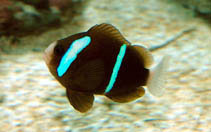
soft rays: 13 - 14. Body and head orange with two black-edged white bars; the first running from the top of the head across the face, just behind the eye; the second from the mid portion of the dorsal fin. Caudal peduncle and caudal fin white.
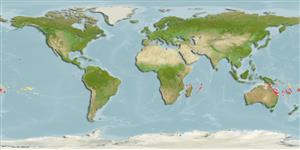
Western Pacific: eastern Australia (Great Barrier Reef and Coral Sea, northern New South Wales), New Caledonia, and Loyalty Islands. Recently reported from Tonga (Ref. 53797).
Allen, G.R., 1991. Damselfishes of the world. Mergus Publishers, Melle, Germany. 271 p.
IUCN Red List Status (Ref. 90363)
Threat to humans
Harmless
Human uses
Aquarium: commercial
More information
ReferencesAquacultureAquaculture profileStrainsGeneticsAllele frequenciesHeritabilityDiseasesProcessingMass conversion
Tools
Special reports
Download XML
Internet sources
Estimates of some properties based on empirical models
Phylogenetic diversity index (Ref.
82805): PD
50 = 0.5000 [Uniqueness, from 0.5 = low to 2.0 = high].
Bayesian length-weight: a=0.02405 (-0.08147 - 0.12957), b=2.96 (2.89 - 3.03), based on LWR estimates for species & family-BS (Ref.
93245).
Trophic Level (Ref.
69278): 2.7 ±0.29 se; Based on food items.
Resilience (Ref.
69278): High, minimum population doubling time less than 15 months (Preliminary K or Fecundity.).
Vulnerability (Ref.
59153): Low vulnerability (23 of 100) .