Environment: milieu / climate zone / depth range / distribution range
Ecology
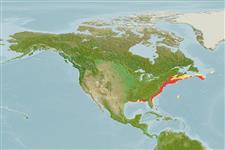
Marine; brackish; demersal; depth range 10 - 183 m (Ref. 5951). Temperate; 54°N - 29°N
Western Atlantic: Newfoundland in Canada to northeastern Florida in USA.
Size / Weight / Age
Maturity: Lm ? range ? - ? cm
Max length : 36.0 cm TL male/unsexed; (Ref. 7251); common length : 20.0 cm TL male/unsexed; (Ref. 3821)
Short description
Morphology | Morphometrics
Dorsal
spines
(total): 0;
Dorsal
soft rays
(total): 8;
Anal
spines: 0;
Anal
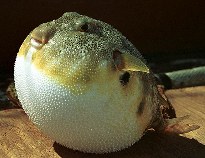
soft rays: 7. Upper side grey or brown with poorly defined black spots and saddles. Belly yellow to white. Tiny jet-black pepper spots (about 1 mm in diameter) scattered over most of pigmented surface, particularly evident on cheeks. Lower sides with a row of black, elongate, bar-like markings. No lappets on head or body (Ref 53033).
Inhabits bays, estuaries and protected coastal waters. Sold as `sea squab' in northern part of range. Feeds primarily on shellfish, occasionally on finfish. Reportedly non-toxic.
Life cycle and mating behavior
Maturity | Reproduction | Spawning | Eggs | Fecundity | Larvae
Robins, C.R. and G.C. Ray, 1986. A field guide to Atlantic coast fishes of North America. Houghton Mifflin Company, Boston, U.S.A. 354 p. (Ref. 7251)
IUCN Red List Status (Ref. 130435)
Threat to humans
Harmless
Human uses
Fisheries: minor commercial; aquarium: commercial
Tools
Special reports
Download XML
Internet sources
Estimates based on models
Preferred temperature (Ref.
123201): 4.9 - 24.4, mean 9.3 °C (based on 71 cells).
Phylogenetic diversity index (Ref.
82804): PD
50 = 0.5000 [Uniqueness, from 0.5 = low to 2.0 = high].
Bayesian length-weight: a=0.02291 (0.01026 - 0.05115), b=2.89 (2.72 - 3.06), in cm total length, based on LWR estimates for this Genus-body shape (Ref.
93245).
Trophic level (Ref.
69278): 4.0 ±0.66 se; based on food items.
Resilience (Ref.
120179): High, minimum population doubling time less than 15 months (K=0.6).
Fishing Vulnerability (Ref.
59153): Low vulnerability (24 of 100).
Climate Vulnerability (Ref.
125649): Low vulnerability (22 of 100).
Nutrients (Ref.
124155): Calcium = 38.7 [16.1, 97.2] mg/100g; Iron = 0.415 [0.167, 0.986] mg/100g; Protein = 18.3 [16.1, 20.6] %; Omega3 = 0.641 [0.299, 1.355] g/100g; Selenium = 15.5 [6.7, 35.4] μg/100g; VitaminA = 7.65 [2.05, 30.83] μg/100g; Zinc = 0.49 [0.34, 0.77] mg/100g (wet weight);